Flooring projects have a funny way of looking simple until you’re on your knees staring at a subfloor that’s not quite flat, not quite clean, and definitely not ready. The truth is, the visible floor—tile, hardwood, vinyl, laminate, even carpet—only performs as well as what’s underneath it. And in 2026, with thinner rigid-core products, faster-setting adhesives, and tighter manufacturer tolerances, “good enough” subfloor work tends to show up later as clicks, cracks, hollow spots, or that one annoying squeak you can’t un-hear.
The good news: subfloor preparation isn’t mysterious. It’s a repeatable workflow: inspect what you’ve got, get it clean, verify moisture, fix the structure, then dial in flatness and texture so your finished floor behaves like it belongs there. To keep it real, we’ll follow a fictional homeowner, Maya, renovating a 1990s condo—concrete slab in the kitchen, plywood in the living room—because mixed subfloors are where prep skills actually matter. By the time you hit installation readiness, you’ll know what to check, what to fix, what to leave alone, and what to never ignore.
En bref
- 🧭 Start with a real assessment: identify materials, damage, and obstacles before you buy anything.
- 🧹 surface cleaning is not “quick vacuuming”—it’s removing adhesives, dust films, and protrusions that break bonds.
- 💧 Do moisture testing early; moisture fixes often take the longest drying time.
- 📏 Flat beats “level”: focus on leveling and smooth transitions so the floor doesn’t flex.
- 🛠️ repair cracks, patch weak spots, and lock down squeaks before you touch underlayment.
- 🧴 Don’t skip priming when using self-leveler or patching products—bond failures are expensive.
- ✅ A final walk-through and straightedge check is how you earn true installation readiness.
Subfloor preparation checklist: assess materials, damage, and obstacles before installation
Maya’s first move isn’t buying boxes of flooring—it’s figuring out what she’s installing over. That sounds basic, but it’s where most DIY plans go off the rails. A subfloor can be concrete (slab), plywood, or OSB, and each one reacts differently to moisture, fasteners, and leveling compounds. If you treat them the same, you’ll eventually pay for it in movement or bond failure.
Start by mapping the space like you’re a detective. In Maya’s condo, the kitchen is slab-on-grade and the living room is wood-framed. That means she’ll likely need different prep products and different expectations for drying time in each zone. She marks transitions, doorways, and any area where the substrate changes, because those are the spots floors love to crack or separate.
How to inspect a subfloor for structural soundness (wood and concrete)
On wood subfloors, the goal is to confirm nothing flexes. Maya walks slowly and listens. A squeak isn’t just annoying—it’s proof of movement, and movement is the enemy of tile and a headache for click-lock products. She checks for soft spots near the dishwasher line and the balcony door, because water doesn’t announce itself politely.
On concrete, she looks for spalling, old adhesive shadows, hairline cracks, and any crumbling edges near walls. Concrete can look fine and still have moisture problems underneath, but visible damage is still a big clue. If you can chip it with a screwdriver, it’s not ready for coatings, patching, or glue-down flooring.
Obstacles to flag early: fasteners, old underlayment, and hazardous materials
This is where you save time later. Maya checks for leftover staples from old carpet tack strips, random screws, and thin luan underlayment (the stuff that loves to delaminate). If she’s renovating an older building, she also watches for legacy materials that may require professional handling. In 2026, many jurisdictions are stricter about disposal and documentation, so it’s not a step to “wing.”
She finishes the assessment by choosing her target tolerances. For many rigid floors, manufacturers often expect tight flatness over a given span (read your product specs). The key takeaway: you’re not guessing—you’re planning. That planning makes the next step, cleaning, actually effective.
Surface cleaning for subfloors: remove debris, adhesive, and contaminants that ruin bonding
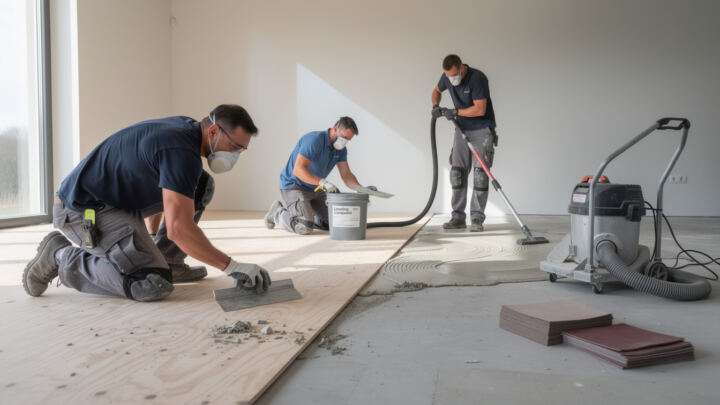
If assessment is the strategy, surface cleaning is the discipline. This is the part people rush, then wonder why their underlayment bubbles or their adhesive “doesn’t stick like the video.” Maya treats cleaning like she’s prepping a surface for paint: anything left behind becomes a weak layer between the subfloor and the new system.
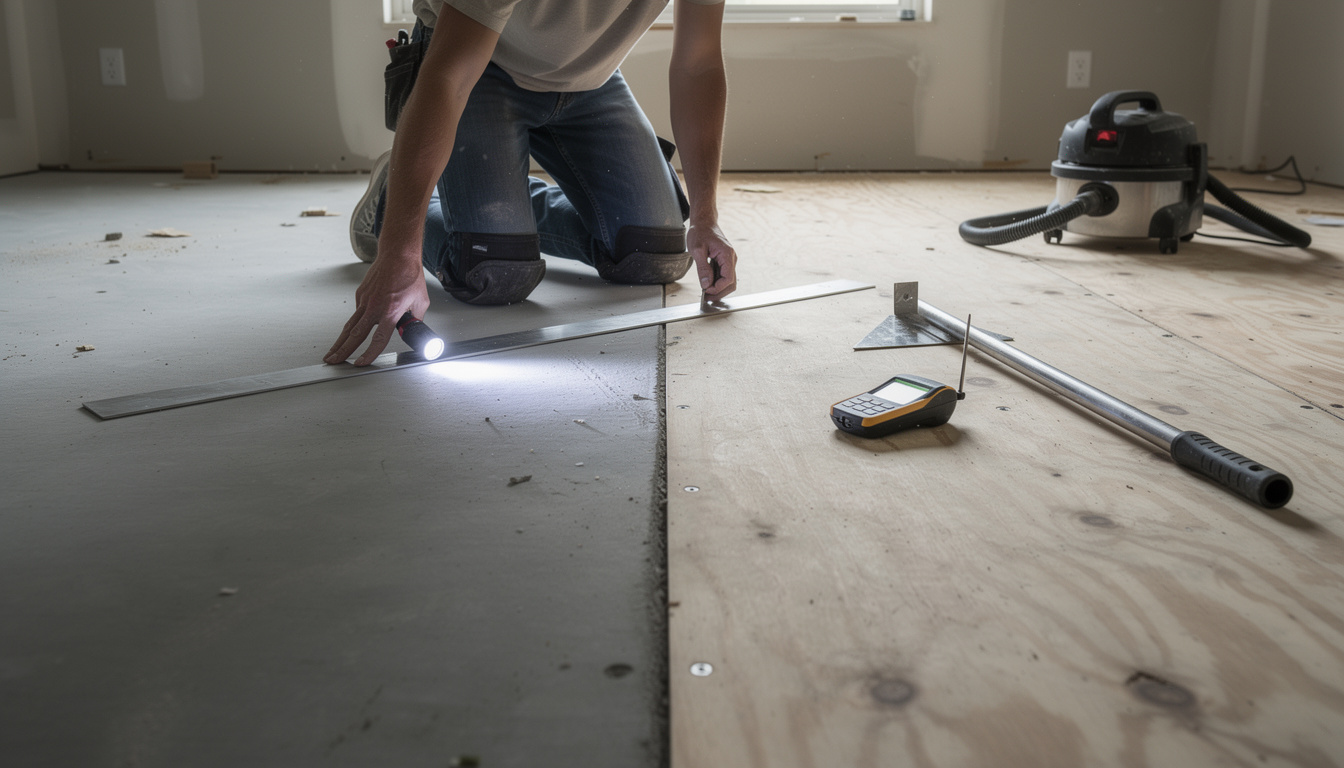
She starts dry: sweep, then vacuum with a proper shop vac (fine dust matters). Dust isn’t harmless—on concrete, it acts like a bond breaker. On wood, it keeps patching products from keying into the grain and can make leveling compounds shear off in sheets later.
What to remove (and why) before patching, priming, or underlayment
Adhesive residue is a big one. Old carpet glue, vinyl mastic, and random construction blobs create high spots and chemistry conflicts. Maya scrapes thick ridges and uses the right remover for the adhesive type, but she avoids leaving oily residue that would sabotage priming later.
She also removes broken tile bits and brittle skim coats. Even if they feel “stuck,” they can pop under stress, especially with floating floors that amplify tiny deflections. Then she checks edges: baseboards and skirtings sometimes need to come off so the new floor can expand and so cleaning can be thorough at the perimeter.
A practical cleaning table (so you don’t miss the usual suspects)
| Debris / Contaminant | Best removal method | Why it matters |
|---|---|---|
| 🧱 Drywall scraps | Hand pick + vacuum | Keeps bumps from telegraphing through thin flooring |
| 🧴 Old adhesive ridges | Scraper / oscillating tool (carefully) | Improves bond for patching and glue-down installs |
| 🔩 Staples / stray nails | Pliers + punch, then vacuum | Prevents punctures, squeaks, and underlayment damage |
| 🌫️ Fine dust film | HEPA vacuum; damp wipe if allowed | Reduces bond failure when priming or using self-leveler |
By the end of cleaning, Maya can run her hand across the floor without grabbing grit or catching on spikes. That’s the vibe you want. Next up: moisture—because a clean surface can still be a wet problem in disguise.
Moisture testing and drying time: prevent warping, mold, and flooring failure
Moisture testing is the step that feels “optional” right up until it’s the only thing that mattered. Maya learned this the hard way in a previous rental: a beautiful vinyl install that started tenting near the patio door after a humid summer. Floors don’t just fail; they slowly report the conditions you ignored.
Moisture can come from below (slab vapor), from above (leaks), or from the air (humidity). In 2026, a lot of homeowners run tighter buildings—better windows, more insulation—which can trap humidity if ventilation isn’t balanced. That makes moisture checks more important, not less.
How to measure moisture in concrete vs. wood subfloors
For wood, Maya uses a moisture meter to spot-check several areas, especially near plumbing lines and exterior walls. One reading in the middle of the room isn’t enough; moisture loves corners and transitions. If the numbers vary a lot across the room, that’s a clue to find a source, not just “wait longer.”
For concrete, she uses appropriate test methods for slab moisture (depending on local practice and flooring requirements). The key is matching the method to the flooring manufacturer’s limits. If the slab is too wet, she plans for mitigation: a compatible vapor barrier system or a moisture-control primer designed for that application.
Moisture symptoms you can see (and the ones you can’t)
Visible signs include staining, efflorescence on concrete, cupping on wood panels, rusting fasteners, and musty odor. But Maya doesn’t rely on smell alone. A slab can be clean, odor-free, and still push vapor hard enough to break down adhesives over time.
She also checks crawl spaces where applicable: ventilation, standing water, torn vapor barriers, and signs of condensation. Moisture isn’t only a flooring issue; it’s a building health issue.
Drying time isn’t a suggestion—it’s a schedule item
When Maya patches a spot or applies a moisture barrier, she treats drying time like concrete: it decides when the next step is allowed. Fast-drying products exist, but “fast” still means following the label for temperature and humidity conditions. Rushing this stage is how you trap moisture under impervious floors and create long-term headaches.
Once moisture is controlled and verified, she’s ready to chase flatness—the step that makes floors feel premium underfoot.
Leveling and patching a subfloor: flatness, transitions, and long-term durability
People say “level,” but what most floors really need is “flat.” Leveling is about correcting slopes when needed, but a perfectly level floor that’s wavy is still a problem. Maya focuses on flatness first because it affects click-lock joints, tile lippage, and even carpet wear patterns.
She uses a long straightedge to find dips and ridges. Then she marks them with a pencil like she’s mapping potholes. It feels a bit extra—until you realize you’re about to lock a finished floor on top of those imperfections for the next decade.
Patching low spots, filling gaps, and repairing weak areas
For shallow dips, Maya uses patching compounds designed for floors. For larger low areas, she considers self-leveling underlayment, but she doesn’t pour it straight onto dusty concrete or thirsty plywood. That’s where priming comes in: primer controls absorption and improves bond so the leveler cures properly instead of drying too fast at the surface and cracking.
She also deals with seams between plywood sheets. Small gaps are normal, but wide gaps and broken edges need attention. If she’s installing a thin resilient product, even a small void can telegraph through over time.
Repair cracks the right way (so they don’t print through later)
On concrete, repair cracks starts with understanding whether the crack is stable. Hairline shrinkage cracks can often be treated with appropriate repair materials, while cracks with vertical displacement suggest movement that needs a bigger plan. Maya cleans cracks thoroughly, uses compatible fillers, and follows product cure times before covering.
On wood, cracks or splits can mean the panel is compromised. Sometimes the best repair is replacing a section, especially if water damage has softened it. This is where “saving time” by ignoring damage becomes expensive later.
Sanding high spots and controlling transitions
Sanding isn’t glamorous, but it’s one of the fastest ways to fix a small high ridge at a seam. Maya uses sanding to knock down proud edges and old compound ridges, then vacuums again. She pays special attention to transitions between concrete and wood areas, feathering patching materials so the finished floor doesn’t feel like it hits a speed bump.
When she can run her straightedge in any direction without obvious rocking or daylight gaps, she knows she’s close. The next step is making sure everything is locked down—because flat surfaces still fail if they move.
Priming, fastening, and installation readiness: lock the subfloor down before flooring goes in
This is the “make it behave” phase: fastening, reinforcing, and making sure products are compatible. Maya treats installation readiness as a pass/fail checkpoint, not a vibe. If anything is questionable now, it will be worse after the flooring is installed—because you won’t want to pull it back up.
Secure the subfloor: screws, joists, and squeak fixes
On plywood, Maya finds squeaks and drives screws into joists (not just into the panel). The goal is to eliminate movement between layers. If a board is delaminating or feels spongy, she replaces it instead of trying to “glue it back to life.”
She also checks edges around vents and doorways where cuts can leave panels unsupported. Adding blocking or reinforcing those areas can prevent flexing that later breaks grout lines or weakens click joints.
Priming before leveling compounds and adhesives (when it actually matters)
Priming isn’t always required for every flooring system, but it’s critical when you’re using self-leveling products or certain patching materials—especially over porous concrete or wood. Maya follows the manufacturer’s pairing: primer + leveler + adhesive systems designed to work together. Mixing brands randomly can work… until it doesn’t, and the failure line usually lands exactly where you tried to save money.
She also respects cure windows. Some primers need a tacky stage; others need full dry. That’s where reading the label beats guessing every time.
Final inspection checklist for true installation readiness
Maya finishes with a deliberate walk-through, straightedge in hand. She checks cleanliness again because sanding dust loves to reappear. She checks moisture logs if she made changes. Then she checks edges and transitions one more time, because that’s where floating floors complain first.
Here’s the checklist she uses before any underlayment or floor planks come out of the box:
- ✅ Flatness verified with straightedge in multiple directions 📏
- ✅ No loose panels, pops, or squeaks—everything fastened tight 🔩
- ✅ Cracks filled and stable; patched areas fully cured 🛠️
- ✅ Primer applied where required, within the correct window 🧴
- ✅ Moisture levels within flooring spec; mitigation cured 💧
- ✅ Surface re-vacuumed after sanding/patching, no dust film 🌫️
When all of that is done, the flooring install stops being a gamble and starts being a build. And that’s the whole point of prep: you’re not just making it look good—you’re making it last.
Can I install new flooring over existing flooring if the surface feels solid?
Sometimes, but don’t assume. You still need subfloor preparation standards: verify flatness, check for trapped moisture, and confirm the existing layer is fully bonded and compatible with your new system. Many floating floors can go over certain surfaces, but glue-down installs usually demand a clean, bare subfloor for reliable adhesion.
What’s the difference between leveling and making the subfloor flat?
Leveling corrects slope relative to gravity; flatness removes waves, dips, and humps. Most modern flooring failures come from lack of flatness, not lack of level. Use a long straightedge to find localized high/low spots, then use sanding for highs and patching/self-leveler for lows.
How long should drying time be after patching or self-leveling?
Drying time depends on the product, thickness, temperature, and humidity. Follow the manufacturer’s cure schedule exactly and don’t trap moisture under underlayment or flooring. If you’re using moisture mitigation or primers, respect their recoat/cover windows too.
Do I really need priming before a self-leveling compound?
In most cases, yes. Priming improves bond and controls how quickly the subfloor absorbs water from the compound. Skipping primer often leads to pinholes, weak surfaces, or delamination—especially on porous concrete and wood subfloors.
What tools make subfloor prep faster without cutting corners?
A shop vac (preferably HEPA), a long straightedge, a moisture meter, a quality scraper/oscillating tool, and the right trowels for patching. These tools make surface cleaning, moisture testing, leveling, and repair cracks work more predictable—so you hit installation readiness with fewer surprises.