Indoor air quality has become one of those “hidden” home issues people actually talk about now—right up there with noise, water taste, and whether your bedroom gets enough daylight. The twist is that you can do everything “right” (good ventilation, a decent vacuum, even an air purifier humming in the corner) and still end up with stubborn air pollution inside your own walls. A big reason is under your feet. Flooring doesn’t just sit there looking pretty; it can release chemicals, trap particles, and even create the kind of micro-environment where mold growth takes off after one leaky dishwasher incident.
According to the EPA, indoor pollutant concentrations can run 2 to 5 times higher than outdoors—and that’s before you factor in modern renovation habits, fast installs, and “new-home smell” materials. From volatile organic compounds and long-tail VOC emissions to the everyday build-up of allergens, dust mites, and dampness, the flooring choices you make can either lighten the load on your lungs or quietly add to it. Let’s break it down with real-life scenarios, practical checks, and what actually matters when you’re choosing (or living with) a floor.
In brief: what to watch for with flooring and indoor air quality
- 🧪 VOC emissions often come from vinyl, laminate, finishes, and especially adhesives—sometimes more than the surface itself.
- 🧹 Soft surfaces can hold allergens (including dust mites and pet dander), while hard floors are usually easier to fully clean.
- 💧 Water + the wrong materials can trigger mold growth under planks, pads, or poorly sealed seams.
- 🌬️ Better ventilation during and after installation can dramatically reduce chemical exposure.
- 🏷️ Certifications like FloorScore®, GREENGUARD, and CRI Green Label Plus help you shop smarter, not harder.
- 🏢 Floor level can change what you breathe: higher levels may have less tracked-in dust, but HVAC balance still decides a lot.
Flooring and Indoor Air Quality: How Materials Become Indoor Air Pollution Sources
Picture a small family renovating a 1990s condo: new paint, new cabinets, and new flooring to “freshen it up.” Two weeks later, someone complains about headaches and a scratchy throat. They blame the paint first, then the dusty construction mess. But the sleeper issue is often the floor system itself—surface layer, underlayment, glue, and finish—acting like a slow-release diffuser for volatile organic compounds.
Many modern flooring products are made with binders, plasticizers, resins, and coatings that can off-gas. This doesn’t mean every vinyl plank or laminate board is “toxic,” but it does mean the mix of materials can push VOC emissions higher, especially right after installation. In the real world, that “new floor smell” is a form of indoor air pollution. If you’ve got limited ventilation (tight windows, mild weather, or a building where opening windows is basically a joke), those chemicals linger longer.
A useful way to think about it is that flooring can be both a source and a sink. It can emit compounds directly (source), and it can also absorb airborne chemicals from cleaning products or outdoor pollution and then re-release them later (sink). That second part surprises people. A heavily fragranced cleaner used weekly can load a home with extra irritants that end up interacting with dust settled on textured surfaces.
There’s also the “hidden layer” effect: adhesives, sealants, underlayments, and padding can matter as much as the floor you see. A click-lock floating floor installed over a foam pad might feel clean and modern, but certain pads can contribute to chemical exposure if they’re not low-emission. Glue-down installations can be even more sensitive because adhesive coverage is large and curing depends on temperature and airflow.
To make this practical, here’s a quick comparison of common emission sources and what they usually mean for day-to-day living.
| Source 🌫️ | What it can release 🧪 | Typical impact on indoor air quality 🏠 | What helps most ✅ |
|---|---|---|---|
| Vinyl flooring | VOC mix from plastics/additives | Higher risk of noticeable off-gassing early on | Low-emission certified product + strong ventilation |
| Laminate | Resins and surface coatings | Can contribute to VOC emissions, varies by brand | Choose certified lines; avoid “mystery” imports |
| Adhesives & sealants | Solvents or reactive compounds | Often the biggest short-term chemical exposure driver | Low-VOC adhesives + curing time + airflow |
| Underlayments/padding | Foam-related emissions | Can add background VOC load | Certified underlayment; skip unnecessary layers |
| Surface finishes | Solvents, hardeners | Spikes during finishing/refinishing | Water-based finishes; isolate area; ventilate |
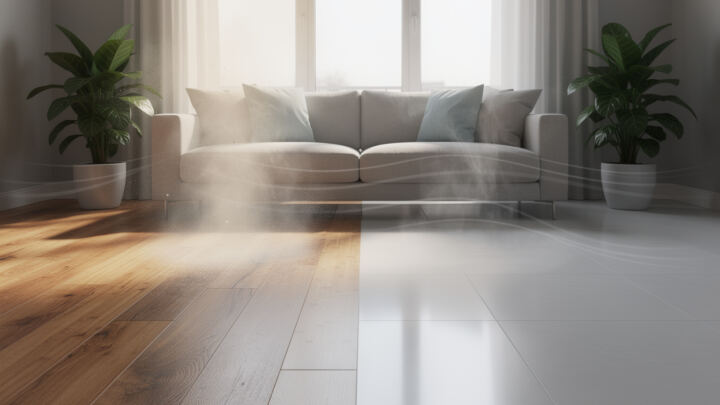
So how do you avoid the “renovation hangover”? Start by treating installation like a short indoor air event. During the first days, keep ventilation high, run HVAC fans with clean filters, and avoid adding new scented products that stack extra irritants on top of the off-gassing. That way, your next section decision—what type of surface to live with—doesn’t get undermined by preventable chemical buildup. The key insight: your floor isn’t just décor; it’s part of your home’s breathing system.
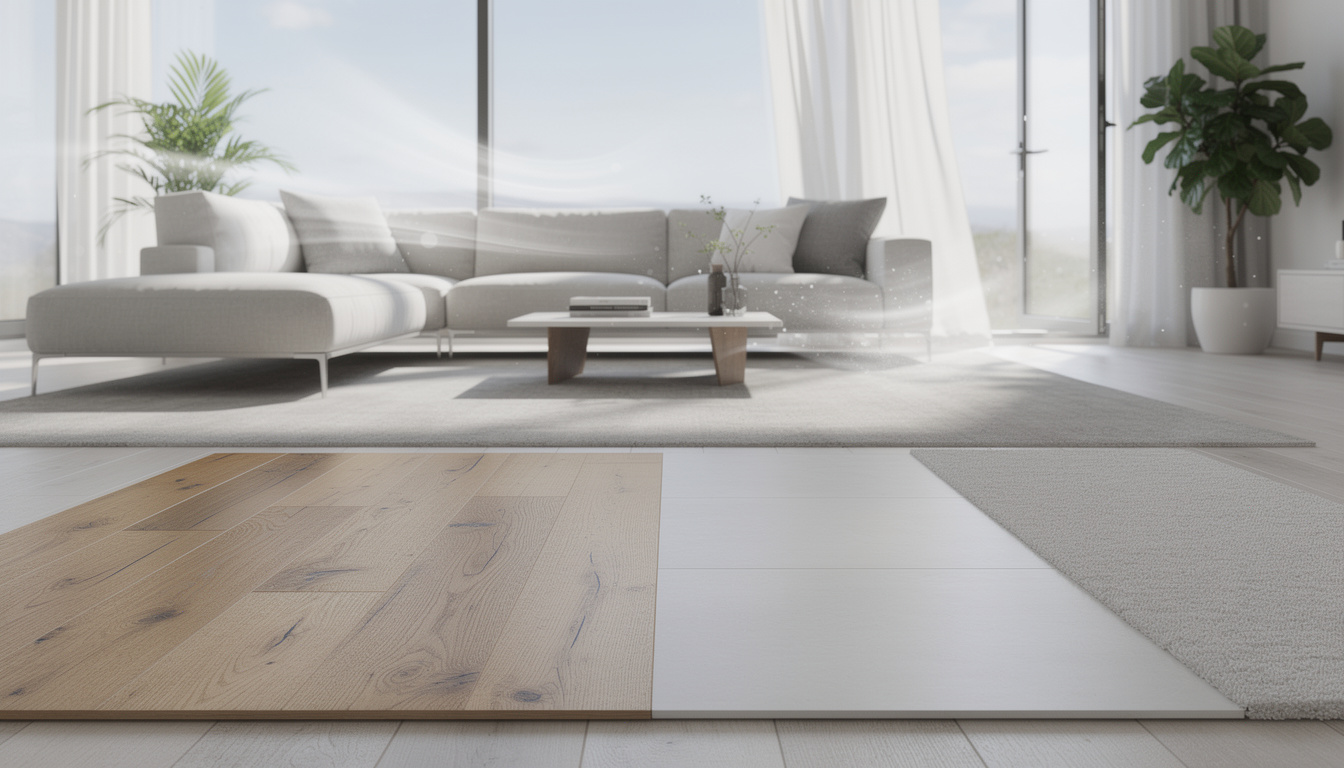
Best Flooring Options for Healthier Indoor Air Quality: What Actually Works in Real Homes
Choosing flooring for better indoor air quality isn’t about chasing a perfect material; it’s about matching your household’s needs to what the floor is likely to do over time. A couple with a dog, a toddler who plays on the ground, and a grandparent with asthma will experience the same floor very differently than a single person in a low-traffic studio.
Hard surfaces tend to be simpler for clean air because they don’t hold onto particles as easily. Solid hardwood is the classic example: it’s durable, it doesn’t offer much “hiding space” for allergens, and it can be cleaned without deep extraction tools. That said, hardwood’s finishes matter. If it’s site-finished, the coatings can temporarily raise VOC emissions. Pre-finished boards often control that better, but quality varies, so certifications become your friend.
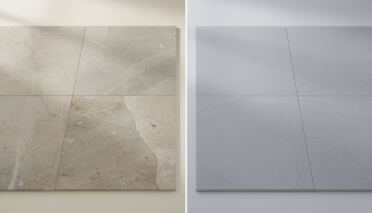
Natural stone tile (like slate or marble) is another strong option for people who want a surface that’s naturally resistant to bacteria and less likely to retain odors. It’s also less hospitable to dust mites. The catch is grout and moisture management: if water penetrates and stays, you can create conditions that encourage mold growth in surrounding materials. Sealing and keeping humidity in check makes the difference between “clean and sleek” and “why does it smell damp?”
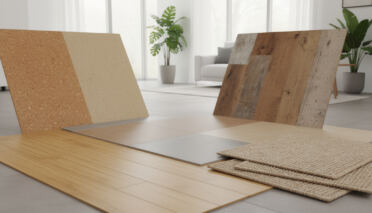
Then there’s the modern “workhorse” category: engineered floors, rigid-core options, and laminates. These can be totally reasonable in 2026—manufacturing has improved, and low-emission product lines are more common than they were a decade ago. The problem is that shoppers often pick based on price and color, then forget to ask about chemical exposure from binders, coatings, and underlayment. That’s where third-party standards matter, not marketing copy.
Certifications don’t guarantee a product is “health magic,” but they do help you avoid the worst offenders. Labels like FloorScore®, GREENGUARD, and CRI Green Label Plus are widely recognized in green building programs because they’re tied to independent emissions testing. If you’re overwhelmed at the store, a simple rule is: choose certified materials not just for the visible flooring, but for the adhesive and underlayment too.
Real-world decision example: “Maya’s townhouse”
Maya (a fictional but very typical homeowner) lives in a three-story townhouse near a busy road. Her biggest complaint is waking up congested and feeling like the home gets dusty fast. She assumes the traffic is the whole story. When she switches the bedroom from old carpet to a certified pre-finished hardwood and upgrades to a low-emission underlayment, the dust load doesn’t magically vanish—but cleaning becomes more effective. She also notices fewer musty odors after rainy weeks because the new surface doesn’t trap dampness in the same way.
The bigger win is that she pairs the change with better ventilation: running the bathroom fan after showers, keeping HVAC filters on schedule, and airing out after cleaning. Flooring didn’t solve everything, but it stopped being a contributor. That’s the goal.
A quick shopping checklist you’ll actually use
- 🏷️ Look for FloorScore® or GREENGUARD on the flooring and underlayment, not just one component.
- 🧴 Ask what adhesive is recommended and whether it’s low-VOC (don’t accept vague answers).
- 🌬️ Plan for ventilation during install: fans, open windows (if possible), and HVAC circulation with a clean filter.
- 💧 If your home is prone to dampness, prioritize moisture-stable systems and skip thick padding that can hold water.
- 🧽 Think about cleaning reality: will you actually deep-clean a plush surface often enough to manage allergens?
Once you’ve picked materials, the next question is where the air is coming from inside the building—because the same flooring can behave differently depending on what floor you live on and how air moves through the space.
To see how building science connects with everyday air movement, it helps to watch a visual walkthrough and then map those ideas to your own rooms.
Indoor Air Quality by Floor Level: Why Upstairs Can Feel Different (and When It Doesn’t)
People love to debate whether higher floors have better indoor air quality. Sometimes they do, sometimes they don’t, and the reason usually has less to do with altitude and more to do with airflow patterns, particle tracking, and HVAC balance. Still, floor level can influence what ends up in your breathing zone, especially in multi-story homes and apartment buildings.
Start with the obvious: ground floors are where more outdoor stuff gets dragged in. Shoes bring in fine particles, pollen, and grime that eventually become indoor air pollution when disturbed by footsteps and vacuuming. If you’ve got carpet by the entrance, it can act like a reservoir for allergens. Hard surfaces near doors can be easier to wipe clean, but they can also let particles resuspend if cleaning is infrequent. It’s not that one is “good” and the other “bad”—it’s about whether the dirt stays trapped until removed or gets kicked back up repeatedly.
Now layer in the “stack effect.” Warm air rises, and that can pull air from lower levels upward through gaps, stairwells, and wall cavities. If the basement has dampness, stored paint, or a musty corner, those odors and compounds can migrate. The upstairs might feel “fresher” simply because it’s warmer and drier, but it can also become the final collection point for whatever is being pulled up. This is where flooring intersects with building mechanics: a basement with moisture-sensitive carpeting can encourage mold growth, and once that starts, the upstairs can still be impacted even if it has immaculate hardwood.
In apartments, the story changes again because you share air pathways—hallways, shafts, and sometimes neighboring units via pressure differences. Higher floors may be farther from street-level exhaust and dust, but they can be closer to rooftop HVAC intakes or subject to different wind pressures. The practical takeaway isn’t “move to the 12th floor.” It’s “control what you can”: keep filtration strong, manage humidity, and choose flooring that doesn’t amplify problems.
Flooring choices that make sense by level
On lower levels, moisture resilience matters. A floating floor over a moisture barrier can be smart if installed correctly, but skipping the barrier is how you end up with that odd, persistent smell after a wet season. In kitchens and entries, tile or well-sealed hard surfaces help you remove contaminants quickly. If you insist on a softer feel, use smaller area rugs you can wash, rather than wall-to-wall carpet that becomes a long-term particle bank.
On upper floors, sound control becomes part of the air discussion. People add thick underlayments for noise reduction, but some pads can contribute to VOC emissions if they aren’t tested. Choosing certified underlayment keeps your “quiet upgrade” from turning into a chemical upgrade too.
And don’t forget the human factor. A household that cooks a lot, uses strong cleaning sprays, or burns candles is adding combustion byproducts and fragrances that interact with surfaces. Flooring that’s easy to clean can reduce how long those residues stick around.
If you want one simple rule: treat the first floor like the “dirt and moisture gateway” and the upper floors like the “comfort zone” that still needs careful materials. Next up, we’ve got the biggest hot-button topic in real homes—carpet—and why it’s both beloved and blamed.
Carpets are emotional. People associate them with warmth, quiet, and comfort, and that’s exactly why the next section gets very real, very fast.
Carpets, Allergens, Dust Mites, and Mold Growth: The Comfort Trade-Off Nobody Explains Well
Carpet is the flooring equivalent of a cozy sweater: comfortable, forgiving, and sometimes a little hard to keep truly clean. For indoor air quality, carpet’s biggest issue isn’t that it automatically “poisons” a home—it’s that it holds onto stuff. That includes allergens like pollen, pet dander, and the tiny particles that feed dust mites. If moisture sneaks in, it can also become a staging ground for mold growth, especially in padding.
Health organizations have long pointed out that carpets can store substantially more allergen material than hard flooring. One widely cited framing (including messaging associated with respiratory health groups) is that carpets can hold dramatically higher allergen loads—sometimes described as orders of magnitude more—because the fibers and backing act like a net. The practical reality: if someone in your home is sensitive, carpet increases the amount of cleaning required to keep symptoms under control. It’s not impossible, just more demanding.
How carpet affects the air hour by hour
In the morning, sunlight warms rooms and people start moving. Every step compresses fibers and releases a bit of what’s trapped, sending particles into the air where they float until they settle again. Vacuuming helps, but not all vacuums are equal; a weak vacuum can actually make things worse by stirring up fine dust without capturing it well. If you’ve ever noticed a “dust smell” after vacuuming, that’s a clue.
Then there’s humidity. If indoor humidity stays high (often above 50–60%), dust mites thrive and musty odors become more common. Add a spill that doesn’t dry fully, and the carpet pad becomes a moisture reservoir. This is how small accidents turn into chronic odor issues. The carpet on top may look fine while the underlayer quietly develops problems.
Making carpet less of a problem (if you really want it)
If carpet is non-negotiable—maybe you’ve got kids who play on the floor or you need sound dampening—your best move is to choose products that reduce chemical exposure and make maintenance realistic. Look for low-emission options certified by programs like CRI Green Label Plus. Natural fiber carpets (like wool) can be appealing, but they still hold particles; they’re not a free pass. The bigger win is pairing a sensible carpet choice with habits that keep it from becoming a storage unit for irritants.
- 🌀 Use a vacuum with strong filtration and consistent suction (and actually replace filters).
- 🧼 Schedule deep cleaning before it “looks” dirty—because the problem is what you can’t see.
- 💧 Treat spills like emergencies: blot, dry thoroughly, and use airflow to prevent mold growth.
- 🌬️ Keep ventilation steady, especially in bedrooms where you spend the most time.
- 🚪 Use entry mats and a shoes-off habit to cut incoming air pollution particles.
In other words, carpet can work, but it asks for a maintenance relationship. Hard floors can be more forgiving for sensitive households because they let you fully remove contaminants instead of storing them. The next (and final) piece is the behind-the-scenes stuff: adhesives, finishes, and how to reduce VOCs without turning your home into a construction zone for weeks.
Reducing VOC Emissions from Flooring: Adhesives, Finishes, Ventilation, and Smarter Installation
If you want to lower VOC emissions in a meaningful way, you focus on the “wet” parts of flooring: adhesives, sealants, and finishes. They’re often responsible for the sharpest spike in chemical exposure during a renovation. Even when the surface product is low-emission, the wrong glue can undo the advantage.
A common scenario: a homeowner buys a certified low-emission floor but lets the installer pick “standard” adhesive because it’s what’s on the truck. The floor looks perfect, but the indoor smell lingers and people feel irritated for days. That’s not bad luck; it’s a system mismatch. A better approach is to specify the full assembly: floor + underlayment + adhesive + finish, all aligned with low-emission goals.
Ventilation strategy that doesn’t feel like overkill
Airflow is the underrated MVP. Strong ventilation during installation and the first week after can cut down how long VOCs hang around at noticeable levels. If outdoor air is reasonably clean, open windows on opposite sides to create cross-breezes. Use fans to push air out rather than just stirring it around. Run your HVAC fan continuously for a few days with a clean filter, but avoid overcooling or overheating because extreme temperature shifts can affect curing and odors.
In dense urban areas where outdoor air pollution is high, you may need a different play: ventilate during lower-traffic times (often late night or midday, depending on the city), and rely more on filtration and controlled airflow rather than wide-open windows all day.
Certifications and what they’re good for
Certifications like FloorScore® and GREENGUARD are helpful because they’re based on independent emissions testing and commonly recognized by green building programs. They don’t say “zero emissions,” but they do signal that the product meets stricter limits than a generic alternative. For carpet, CRI Green Label Plus is a practical shorthand for lower emissions. The big win is reducing guesswork when you’re staring at 40 nearly identical boxes on a showroom wall.
Mini case study: the “48-hour reset” after installation
After a small flooring project, one household planned a simple two-day reset: they arranged to sleep elsewhere the first night, ran continuous ventilation and HVAC circulation, kept interior doors open for airflow, and delayed bringing in new rugs or furniture that could trap odors. When they returned, the “new floor smell” was much milder, and it cleared fully within the week. The floor didn’t change—behavior did. That’s why installation planning is part of indoor air strategy, not an afterthought.
Once you treat flooring like a system and not a single product, you stop getting surprised by lingering odors and irritation. And if you still have questions, the quick Q&A below covers the ones people ask most when they’re trying to balance design, budget, and breathing easier.
Which flooring is best for indoor air quality if someone has allergies?
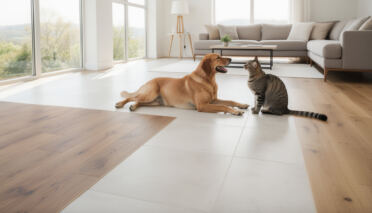
Hard surfaces like solid hardwood or well-sealed tile are usually easier to fully clean and less likely to store allergens like dust mites and pet dander. If you choose carpet, pick a low-emission option (for example CRI Green Label Plus) and plan on frequent vacuuming with good filtration plus periodic deep cleaning.
Are VOC emissions only a problem right after installation?
They’re often strongest right after installation, but some materials can off-gas at lower levels for longer—especially if ventilation is weak or temperatures rise. Adhesives, sealants, and certain finishes can create the biggest short-term spike in chemical exposure, so low-VOC products and strong ventilation during curing matter.
Can higher floors in a building have better indoor air quality?
Sometimes. Higher levels may get less tracked-in dirt and fewer ground-level particles, but indoor air quality still depends on ventilation, HVAC balance, humidity, and what’s happening on lower levels (like damp basements that can drive mold growth and odors upward via the stack effect).
What certifications should I look for when buying flooring?
FloorScore® and GREENGUARD are common markers for lower emissions in hard flooring and related components. For carpet, CRI Green Label Plus is widely used. The best approach is to check not only the flooring but also underlayments and adhesives, since those can drive VOC emissions.
How can I reduce mold growth risk with new flooring?
Control moisture first: fix leaks fast, keep indoor humidity in a healthy range, and use appropriate moisture barriers where needed. Avoid thick padding in damp-prone areas, dry spills thoroughly with airflow, and choose materials that don’t trap moisture—because mold growth often starts underneath where you can’t see it.