In brief
- 🧭 Use area rugs to stop the “floating furniture” look and make every seating zone feel intentional through smart rug placement.
- 📏 Avoid the “postage stamp” mistake by matching the rug to room size and keeping an 18-inch border of bare floor where possible.
- 🍽️ In dining rooms, the 24-inch chair rule keeps chairs from catching the edge (and keeps guests from silently judging your setup).
- 🎨 Build flooring aesthetics with color coordination, using visual weight to make spaces feel cozier or airier.
- 🧶 Create instant depth with texture contrast (flatweave vs. plush pile) instead of buying new furniture.
- 🐾 Pick fibers that match real life: wool for resilience, nylon for high-traffic durability, polypropylene for stain resistance.
- 🛡️ A quality rug pad protects hardwood, reduces slipping, and can extend rug life by about 25%.
- 🧼 Blot spills (don’t scrub), use cold water, and call a pro when odors or deep grit show up.
You can have the perfect sofa, the right paint color, and a gallery wall that looks like it belongs in a boutique hotel—and still feel like something’s off. That “off” is often the floor. In a lot of homes, especially open layouts with continuous wood or tile, furniture can read like it’s hovering, as if the room never fully decided what it wanted to be. Interior design pros have a name for it: the floating effect. And the fix is rarely a renovation. It’s usually one smart textile choice that turns random pieces into a clearly defined scene.
That’s where area rugs quietly do their best work. They set boundaries without adding walls, add comfort without adding clutter, and sharpen your home decor story in a way that paint alone can’t. A rug can be the focal point that organizes everything—art, seating, lighting—while also doing unglamorous jobs like protecting finishes and calming echoey acoustics. The fun part is that once you understand a few sizing rules and a little color logic, you stop “decorating” and start designing on purpose.
Area Rug Placement Rules That Instantly Upgrade Flooring Aesthetics
If your goal is style enhancement, start with placement, not pattern. The most common mistake is buying a rug you love and dropping it in the center like an afterthought. That’s how you get the “postage stamp” look: a nice rug that somehow makes the room feel smaller and more disconnected. The fix is scale plus connection—your furniture needs to physically relate to the rug so the eye reads one composed zone, not scattered objects.
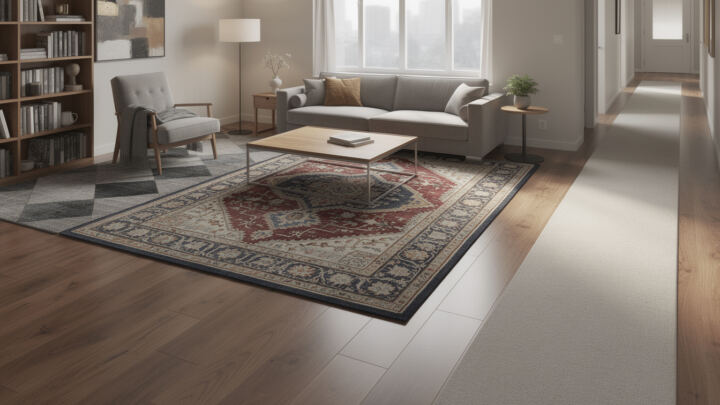
A reliable designer guideline is the 18-inch border rule. Ideally, leave about 18 inches of bare floor between the rug edge and the walls so your flooring frames the rug like a mat around artwork. It’s not a law, but it’s a strong target for living rooms where you want your floors to still shine while the rug does the organizing. In tighter apartments, you might not hit 18 inches on every side; what matters is that the rug looks deliberate, not “whatever fit the sale rack.”
The Two-Leg Rule: The simplest fix for “floating furniture”
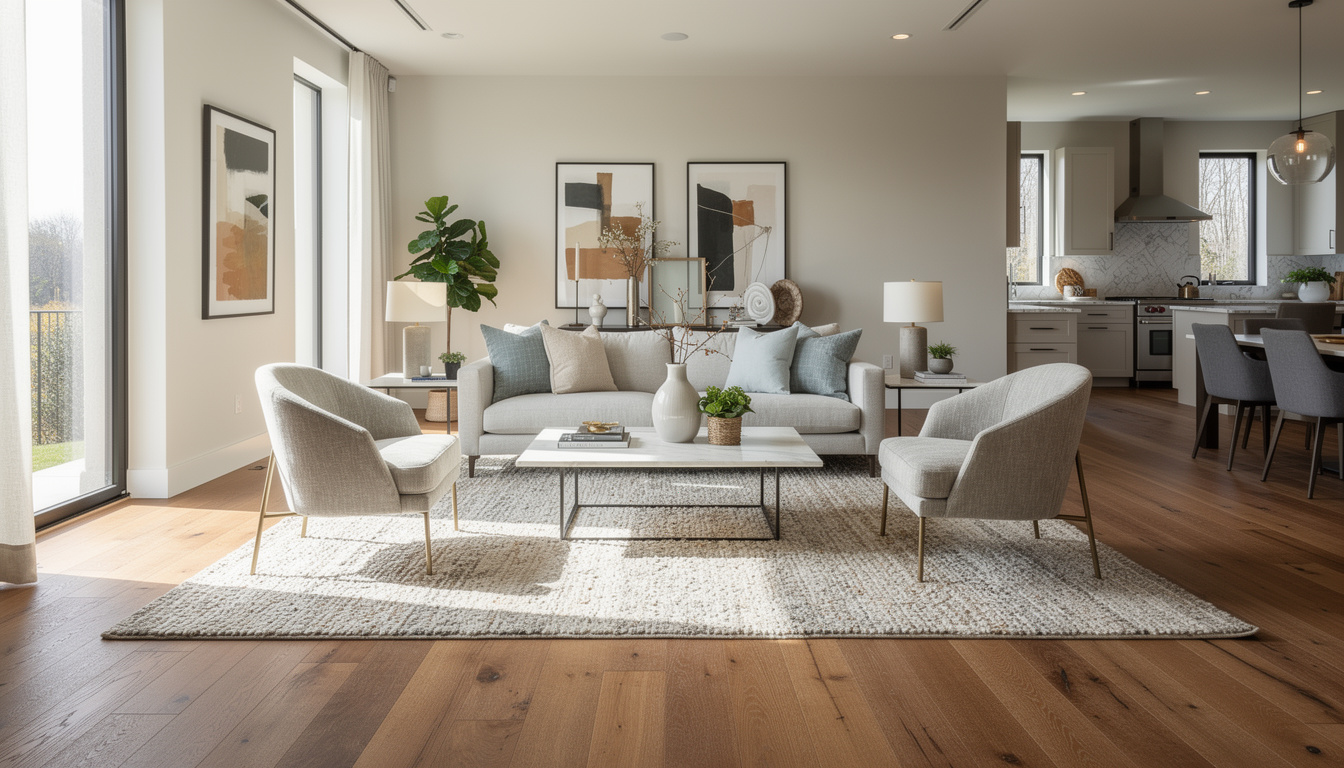
When people say a room feels unfinished, it’s often because seating doesn’t “land” anywhere. The two-leg rule solves that fast: place the rug so the front legs of the sofa and chairs sit on the rug. Instantly, the coffee table and seating become a group instead of islands. If you’ve got a bigger rug (or a big open-concept space), you can go all-in with all legs on for an even more anchored look.
Here’s a quick real-life example. Maya (a fictional but very relatable homeowner) had a gorgeous oak floor and a modular sofa, but her living room felt like a showroom that forgot the final step. Switching from a small 5×8 to an 8×10 and sliding the rug under the sofa’s front legs made the whole layout read like a “conversation area,” not “furniture storage.” That’s the power of placement over purchases.
Room size and standard rug dimensions (so you don’t guess)
Sizes aren’t glamorous, but they’re the backbone of flooring aesthetics. In many standard living rooms, 5×8 rugs end up only fitting under the coffee table, which exaggerates emptiness around it. 8×10 is the workhorse size for average spaces because it typically accommodates the two-leg setup comfortably. If your room is wide or open-plan, 9×12 often lets every piece sit fully on the rug, making the space feel polished and intentional.
| Option 📏 | Best for 🏠 | Visual effect 👀 | Common pitfall ⚠️ |
|---|---|---|---|
| 5×8 🧩 | Small apartments, compact seating | Light zone definition | “Postage stamp” look in most living rooms |
| 8×10 ✅ | Average living rooms | Anchors seating with two-leg rule | Can feel tight if furniture is oversized |
| 9×12 🏗️ | Open layouts, large sectionals | Full “all legs on” cohesion | Needs enough border to avoid wall-to-wall vibes |
Once your living room looks grounded, the next challenge is movement—especially in dining areas where chairs are constantly sliding and scraping, and rug edges become a daily annoyance if you get the math wrong.
Dining Room Rug Placement: The 24-Inch Chair Rule for Smooth, Safe Entertaining
Dining rooms are where good intentions go to die—usually when someone pulls out a chair and it catches the rug edge. That tiny snag moment is more than annoying; it’s a safety issue and it makes your setup feel amateurish. The fix is simple and very measurable: the 24-inch chair rule. You want about two feet of rug extending beyond the table on every side so chairs stay fully on the rug even when people scoot back.
To size it correctly, measure your table length and width, then add 4 feet to each dimension. That gives you the “extended” rug size that accounts for chair movement. For example, a 72″ × 40″ table generally wants a rug around 120″ × 88″ (10′ × 7’4″), which often means shopping close to an 8′ × 10′ depending on orientation and available sizes. Nobody at the dinner party needs to know the math—you’ll just look like you have your life together.
Texture choices that make dining rooms feel effortless
Even when the rug is the right size, texture matters. Thick, high-pile rugs can trap chair legs like they’re walking through snow. That gets old fast and can even damage fibers over time. Dining rooms usually do best with a flatweave or a low-pile rug that lets chairs glide smoothly. This is where texture contrast becomes a design tool: a flat, structured rug under a warm wood table can look crisp and tailored, especially if you pick a subtle pattern that hides crumbs between cleanings.
Maya learned this the hard way when she tried a plush shag under a mid-century dining set because it looked cozy online. In real life, every chair pull felt like a workout, and the rug started looking messy where legs repeatedly pressed down. Swapping to a low-profile weave fixed the function and actually made the room feel more “designed,” because the lines looked cleaner.
Color coordination that supports food, light, and mood
Dining spaces are high-risk for stains, so color coordination isn’t just aesthetic—it’s strategic. Mid-tone patterns (think layered neutrals, gentle geometrics, or traditional motifs with a few colors) are forgiving. Solid light rugs can be stunning, but they’ll show every drip of coffee like evidence in a crime drama. Very dark rugs hide stains but can make the zone feel heavy unless you balance them with lighter walls, airy curtains, or warm lighting.
If you want the rug to be the focal point, pick a pattern that contrasts with the floor but still echoes something else in the room: a stripe color that matches the art frame, a muted tone that repeats in your ceramics, or a warm accent that connects to wood finishes. It’s not about perfect matching—it’s about repetition that feels intentional. Next up: choosing fibers and construction that won’t fall apart the moment real life starts happening.
Choosing Area Rug Materials for Long-Term Style Enhancement (Wool, Synthetics, Jute, Sisal)
Material is where home decor dreams meet reality. A rug can look incredible on day one and still be a terrible choice for your lifestyle—pets, kids, muddy shoes, or just a household that actually lives in the space. Think of fibers like clothing: you wouldn’t wear a delicate cashmere sweater to paint a fence. The good news is that you can absolutely get great interior design vibes and durability; you just need to match the rug to the job.
Wool vs synthetics: resilience, stains, and how they age
Wool is the premium workhorse. It bounces back from pressure because the fibers behave like little coils, and it contains lanolin, a natural oil that helps repel some spills. In busy living rooms, that springy structure keeps the rug looking “alive” instead of flattened. It costs more upfront, but it tends to age gracefully—more like a leather jacket that gets better with time.
Polypropylene is a popular budget-friendly pick because it’s stain resistant and easygoing, but it can suffer from fiber crushing in heavy traffic areas. Once it mats down, it often stays that way. Nylon is typically the toughest synthetic for wear and tear, making it a smart choice for entryways or hallways where footsteps are relentless. If you’ve ever bought a synthetic rug and noticed a chemical smell, that’s off-gassing; airing out the room for a few days usually clears it.
High-traffic zones and solution-dyed practicality
Entryways are brutal. You’re dealing with grit, moisture, and constant abrasion. In these spots, durability beats romance. Look for tough weaves and, if you’re going synthetic, consider solution-dyed fibers—color runs all the way through the yarn instead of sitting on the surface. That means you can clean more aggressively (sometimes even with diluted bleach on certain products) without destroying the pattern. It’s not fancy, but it’s the kind of choice that keeps your space looking good in February when the weather is doing the most.
The green choice: sisal and jute (and their honest limits)
If you want an earthy, relaxed look, plant fibers are a vibe. Jute feels softer underfoot—like a chunky knit texture—so it works nicely in low-traffic lounges or bedrooms where you want warmth without too much fuss. Sisal is tougher (made from agave leaves), so it can handle more foot traffic and still look structured.
But here’s the catch: these fibers hate moisture. They’re absorbent, and in damp spaces they can warp or develop mildew. So if your basement gets humid, skip the natural-fiber rug fantasy down there. Use them where the air stays dry and predictable. Next we’ll get into construction, because two rugs can look identical from above and be wildly different in quality underneath.
Construction, Patterns, and the Focal Point Effect: Making Rugs Look Expensive (Even When They Aren’t)
The price jump between two similar-looking rugs can be shocking: $200 vs $2,000 and you’re left thinking, “Is this a prank?” Usually, it’s construction. Flip the rug corner and the story becomes obvious. A well-made rug doesn’t just look nicer—it holds its shape, wears evenly, and keeps your flooring aesthetics looking intentional instead of tired.
Hand-knotted vs hand-tufted vs machine-made: what to check
Hand-knotted rugs are made by tying individual knots onto a warp-and-weft foundation. The back typically mirrors the pattern on the front, with slight irregularities that are actually a good sign. Machine-made rugs usually have a very uniform, perfect grid on the back. Hand-tufted rugs sit in the middle: yarn is punched through a backing and then held with glue, often covered by a canvas layer. They can look great, but they’re not the same as knotted construction in longevity.
Fringe is another tell. If the fringe is sewn on after the fact, it’s decorative, not structural. In a true knotted rug, fringe is basically the foundation threads continuing outward. These details matter because they affect how the rug holds up under furniture weight and foot traffic.
| Construction 🧵 | How to spot it 👀 | Typical cost range 💸 | Best use ✅ |
|---|---|---|---|
| Power-loomed ⚙️ | Perfectly uniform backing grid | $5–$15 per sq ft | Budget rooms, rentals, trend testing |
| Hand-tufted 🔧 | Canvas backing over glued yarn | $15–$30 per sq ft | Mid-range home decor upgrades |
| Hand-knotted 🏛️ | Back mirrors pattern; slight irregular knots | From ~$50 per sq ft | Long-term investment pieces |
Pattern reading: medallions, borders, and “abrash” as a quality clue
Classic Persian-style layouts are basically visual architecture. A central medallion works like a floor chandelier, anchoring attention. The “field” sets the mood (deep and dramatic, or light and breezy), and borders frame the whole thing so the pattern doesn’t feel like it’s spilling into the room. That framing helps the rug function as a focal point without turning into visual noise.
When a handmade rug has slight shade variations across the same color, that can be abrash—natural shifts from hand-dye batches. It’s not a flaw; it’s personality. In 2026, plenty of mass-produced rugs mimic this effect with printing, but real abrash tends to look organic, not repetitive. The final piece of the puzzle is how you keep all this looking good day-to-day: pads, cleaning, and the stuff nobody posts on social media.
Comfort, Acoustics, and Maintenance: Protecting Floors While Keeping Area Rugs Looking Sharp
There’s the visual side of rugs, and then there’s the lived-in side. Hard floors plus open layouts can turn your home into an echo chamber where footsteps and TV sound bounce around. Textiles are one of the easiest ways to dampen that harshness—no construction required. Rugs also create “soft zones” that feel good, like giving your feet a warm landing spot after a long day. That comfort is real, and it’s a big part of why rugs are so effective in interior design beyond looks.
Rug pads: the quiet hero for hardwood and safety
Putting a rug directly on hardwood can lead to two problems: slipping and micro-scratching. Some rug backs are abrasive, and tiny movements over time can act like sandpaper on your finish. A quality pad acts as a barrier and shock absorber. It also helps the rug lie flatter and can extend the rug’s lifespan by roughly 25% by reducing friction and absorbing impact.
Pick the pad based on what you need. Felt adds cushion. Rubber grip pads focus on traction. Avoid cheap PVC pads, which can react with finishes and leave sticky marks. If edges curl, corner grippers are a smarter long-term fix than relying on tape that fails in high-traffic spots.
Low pile vs high pile: maintenance reality (and robot vacuum drama)
Pile height is just fiber length, but it changes everything. High-pile rugs feel plush and can help absorb sound, which is great in bedrooms. The trade-off is maintenance: dust and pet hair sink in, and dense shag can tangle brush rollers—robot vacuums love getting stranded there like it’s quicksand.
Low-pile rugs are easier to vacuum because debris stays closer to the surface. If your household includes pets, allergies, or lots of foot traffic, low pile often keeps your life simpler. If you crave cozy underfoot comfort, use a plusher rug in a low-mess room and keep food zones flatter and more practical.
Shedding, spills, and when to call a pro
New wool rugs commonly shed for three to six months because they’re made of staple fibers twisted into yarn. That fuzz is normal break-in. Vacuum with suction only, raise the vacuum height, and skip aggressive motorized brushes that can tear fibers. If heavy shedding keeps going past a year, it often points to weaker construction.
For stains, blot—don’t scrub. Scrubbing drives the spill deeper and distorts fibers. A simple spot mix works for many messes: cold water, a little white vinegar, and a small amount of clear dish soap. Hot water can set stains like heat-setting dye in fabric, so keep it cold and controlled.
Deep dirt is the sneaky enemy. Grit settles below the surface and creates a “sandpaper effect” that slowly cuts fibers as you walk. If the rug smells musty or strongly of pets when you get close, that’s a good signal it needs professional sub-surface cleaning. This is how you keep your rug looking like intentional style enhancement rather than a tired floor accessory.
Quick maintenance checklist (because you’ll actually use it):
- 🧲 Vacuum weekly with the right setting (suction-only for wool).
- 🧯 Handle spills fast: blot, treat lightly, rinse-blot with cold water.
- 🛡️ Use a proper pad to stop slipping and protect finishes.
- 🧼 Schedule a professional wash every few years if traffic is heavy or odors build up.
How do I stop my living room from looking unfinished or like the furniture is floating?
Use rug placement to connect the furniture to the floor. Aim for the 18-inch border rule where possible, and size the rug so at least the front legs of your sofa and chairs sit on it (the two-leg rule). In many standard rooms, 8×10 works well; 9×12 is great for open layouts where you want all legs on.
What size rug should I use under a dining table so chairs don’t catch the edge?
Follow the 24-inch chair rule: add 4 feet to both the table’s length and width so there’s about two feet of rug beyond the tabletop on every side. This keeps chairs fully on the rug when pulled out. Flatweave or low-pile rugs make chair movement smoother than thick pile.
Which rug materials are best for pets and high-traffic areas?
Nylon is typically the toughest synthetic for heavy traffic, while polypropylene is very stain resistant and budget-friendly but can crush under weight. Wool costs more but rebounds well and naturally repels some spills thanks to lanolin. In muddy entryways, solution-dyed synthetics are especially practical because the color runs through the fiber, allowing stronger cleaning without fading the pattern.
How can I tell if a rug is hand-knotted, hand-tufted, or machine-made?
Flip a corner and check the back. Power-loomed rugs look perfectly uniform. Hand-tufted rugs often have a canvas backing covering glue. Hand-knotted rugs show the pattern on the back with slightly irregular knots. Also check fringe: if it’s sewn on later, it’s usually not a true hand-knotted foundation.
What’s the safest way to clean spills on wool or other natural fibers?
Blot immediately—don’t scrub. Use a small amount of a gentle mix (cold water, a bit of white vinegar, and a squirt of clear dish soap), then blot-rinse with cold water. Avoid hot water because it can set stains. If the rug smells musty or strongly of pets, or if dirt seems embedded, schedule professional sub-surface cleaning instead of renting a hot steam machine.