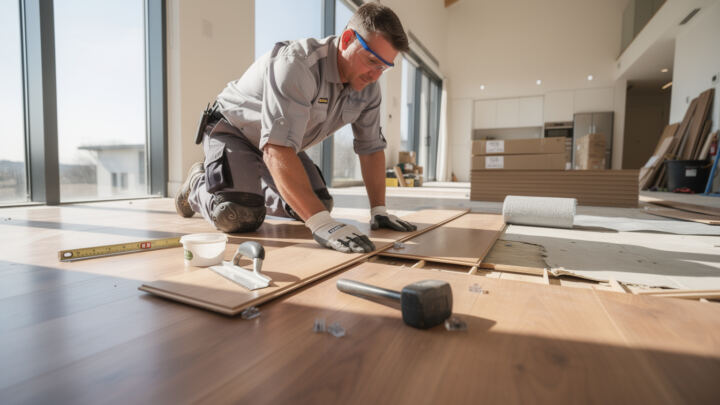
New flooring looks like a design decision, but it behaves like a construction project. The difference matters. A pro install isn’t just someone “putting boards down”; it’s a chain of decisions—about moisture, flatness, timing, and details—that determines whether your floor feels solid and quiet or starts clicking, cupping, and separating a few seasons later. If you’re planning a refresh for a condo, a busy family home, or a small office suite, knowing what’s about to happen reduces stress and helps you spot the difference between normal disruption and actual red flags.
Expect a rhythm: a consult and measuring session, material delivery and staging, serious flooring preparation, then the install day(s) where the crew moves fast but checks constantly. Along the way you’ll hear terms like subfloor inspection, floor leveling, layout planning, adhesive application, and cutting and fitting. Those aren’t fluff—they’re the steps that protect your investment. The best part: once you understand the workflow, you can prep smarter, ask sharper questions, and get a finished floor that feels like it was always meant to be there.
- 🧭 Expect a consult + precise measurements before anything gets ordered, especially if you want patterns, borders, or custom trim.
- 📦 Material delivery often happens days before install so products can acclimate (critical for wood-based floors).
- 🧱 The “boring” part—subfloor inspection and floor leveling—is where long-term performance is decided.
- 🧩 Layout planning and cutting and fitting are what make a room look balanced, not “slapped together.”
- 🧴 For glue-down systems, clean technique in adhesive application prevents bubbles, shifting, and seam issues.
- 🧹 Clean up + final inspection should be a real walkthrough, not a quick wave from the doorway.
Consultation, Measuring, and Layout Planning: Where a Great Install Actually Starts
A professional flooring job usually begins with a conversation that’s half design and half logistics. The installer (or project manager) will ask how you live in the space: pets that race through hallways, rolling office chairs, wet boots by the entry, or direct sun that bakes the living room every afternoon. This isn’t small talk—your answers influence material recommendations, underlayment choices, and even the direction the planks run.
Take a fictional but very real-feeling example: Mia, who runs a small therapy practice from a converted front room, wants a calm look and quiet footfall. During the consult, the pro suggests a thicker underlayment for sound control and a matte finish that hides scuffs between cleanings. Same “flooring project,” different priorities than a rental unit where turnover speed matters most.
Measurements that go beyond square footage
Pros don’t just measure length times width and call it done. They look for tricky transitions, door clearances, radiator pipes, stair noses, and whether your baseboards are staying or getting replaced. They also account for waste factors: a simple rectangular room needs less overage than a space with angled walls or a herringbone pattern.
This is also when you should speak up about the look you want. If you want a specific plank alignment at the entry or a tile layout that centers on a vanity, say it now. Layout planning is easier (and cheaper) on paper than after the first row is down.
Quotes, scope, and what “done” means
A solid quote describes what’s included: moving furniture or not, old floor removal, subfloor repairs, transitions, baseboards, and disposal fees. In 2026, many crews also offer virtual quoting for straightforward jobs, but an on-site visit is still the gold standard if the home is older or you suspect uneven floors.
To keep expectations grounded, here’s a quick cost snapshot many homeowners use as a starting point. Local pricing will vary, so comparing multiple bids is still the move.
| Floor type | Typical installed range (per sq. ft.) | What often drives the price up |
|---|---|---|
| Hardwood 🪵 | $8–$14 | Stairs, custom stains, moisture mitigation |
| Laminate 🧩 | $6–$9 | Complex cuts, premium underlayment |
| Vinyl/LVP 💧 | $5–$7 | Extra floor leveling, heavy furniture handling |
| Tile/Stone 🧱 | $10–$20 | Waterproofing, patterns, substrate upgrades |
| Carpet 🧶 | $4–$8 | Stairs, premium pad, tricky seams |
The key insight: a “fair” price is the one that matches the real scope. If the quote ignores subfloor realities, the bill usually shows up later in change orders.

Flooring Preparation and Subfloor Inspection: The Unseen Work That Prevents Future Headaches
If you want the part of the project that separates pros from weekend warriors, it’s flooring preparation. Most floor failures don’t start at the surface—they start underneath. That’s why the crew focuses on subfloor inspection before they ever commit to the first plank or tile.
On day one (or sometimes a dedicated prep day), the team checks for squeaks, soft spots, moisture issues, and height differences between rooms. In older homes, it’s common to find a patchwork of past repairs: a little plywood here, a dip from a removed wall there, or an old adhesive layer that never fully came off. None of that is “rare.” The question is whether it’s addressed correctly.
Removal of old flooring without wrecking what’s below
If you’re replacing existing material, removal can be quick (floating laminate) or slow (tile with thick mortar). Good installers protect walls, doors, and vents while they work. They’ll also control dust because demo dust has a way of traveling to the one room you thought was safe.
A practical tip: ask where debris is staged and how it leaves the property. If you’ve got a narrow driveway or a shared building hallway, planning this prevents neighbor drama and accidental damage fees.
Floor leveling: flat is not the same as “looks fine”
Floor leveling is where you’ll see laser levels, long straightedges, and sometimes self-leveling compound. Many modern products (especially click-lock LVP and laminate) have strict flatness tolerances. A floor can look okay to the eye and still be uneven enough to cause clicking joints, stress fractures, or a trampoline feel.
Here’s a mini case: Jordan bought a 1990s townhouse and picked wide-plank engineered wood. The crew found a shallow dip running across the living room—barely noticeable until you roll an office chair over it and it pulls you off-line. They leveled that area and re-secured a few subfloor panels. Result: no squeaks, no bounce, and the planks stayed tight through the first humid summer.
Acclimation and staging after material delivery
Material delivery isn’t just a truck dropping boxes. Pros check packaging condition, dye lots (for tile), plank consistency, and whether you received the right transitions and trim. Then they stage it indoors so it can adjust to the home’s temperature and humidity. Wood and wood-based products change dimensionally; rushing this step is how gaps or edge lift show up later.
This section’s takeaway: the floor you walk on is only as stable as the surface it’s attached to—prep work is basically invisible insurance.
Want to see how pros evaluate subfloors and prep rooms? The next section gets into the day-of workflow and why pacing matters.
The Installation Process Day-by-Day: Cutting and Fitting, Adhesive Application, and Quiet Craftsmanship
The actual installation process feels like controlled momentum. A good crew moves quickly, but not sloppily: they’ll dry-fit, re-check measurements, and constantly adjust so lines stay straight. If you’re home during the work, expect noise, sawdust (even with vacuums), and a steady stream of in-and-out movement. That’s normal. What you don’t want is chaos—tools everywhere, no protection on nearby surfaces, and nobody able to explain the next step.
Hardwood and engineered wood: expansion gaps are not optional
With nail-down hardwood, you’ll hear the rhythm of fastening as the rows progress. For floating engineered systems, the crew clicks and locks planks, keeping consistent spacing. Either way, they leave expansion gaps at walls and fixed objects, then cover them with trim. Skipping that gap can lead to buckling later, especially in climates with big humidity swings.
Cutting and fitting is where craft shows up. Around door jambs, vents, and corners, the best installers make cuts that look intentional, not like a rough outline. If you’ve ever seen a floor with awkward skinny slivers near one wall, that’s usually a sign layout wasn’t planned before the first row was installed.
Laminate and LVP: speed is great, but flatness rules everything
Laminate and click-lock vinyl can go down fast, which is why they’re popular for quick renovations. But they’re picky about the subfloor. If prep was rushed, the joints can separate or feel hollow. Pros keep checking the floor as they go, not just at the beginning.
They’ll also plan transitions between rooms: where the floor changes direction, meets tile, or ends at sliding doors. Those little profiles aren’t “extras”; they protect edges and help the floor move as designed.
Tile and stone: alignment, mortar technique, and cure time
Tile installs have their own tempo. The crew spreads mortar, sets tile, checks spacing, and uses leveling systems when needed. This is also where “pretty” meets “practical”: the layout should land symmetrically in visible areas, but cuts should be hidden under toe-kicks or behind doors when possible.
If your project includes showers, laundry rooms, or entries, waterproofing steps matter as much as the tile itself. Rushing cure times is a classic mistake; pros protect the area so no one walks on it too early.
Glue-down systems and adhesive application
For glue-down vinyl, carpet tiles, or some engineered wood, adhesive application is the make-or-break move. Too much adhesive and you risk bleed-through; too little and corners lift. Pros follow manufacturer trowel specs, respect open time, and keep the workspace clean so grit doesn’t get trapped under the surface.
The insight to hold onto: the install day is when the room transforms, but it’s also when tiny shortcuts become permanent.
Next up: how to live through the disruption—what you should move, what to protect, and how to keep the project on schedule without hovering.
How to Prepare Your Home (and Your Brain) for a Smooth Professional Install
The most successful projects aren’t the ones with the fanciest materials—they’re the ones where everyone knows the plan. Homeowner prep reduces delays, protects your stuff, and keeps the crew focused on quality instead of obstacle courses. If you’ve got pets, kids, or a work-from-home schedule, think of this as managing a short, intense renovation sprint.
A practical pre-install checklist you can actually follow
- 📦 Clear small items, fragile decor, and electronics from the work zone (and from nearby shelves—vibration is real).
- 🪑 Ask upfront if the crew moves heavy furniture or if you need movers; don’t assume either way.
- 🚪 Decide what happens with baseboards: reuse, replace, or add quarter round—each choice changes labor and look.
- 🐾 Plan pet boundaries and bathroom breaks; open doors during material delivery and hauling are escape opportunities.
- 🌬️ Make HVAC access clear and replace filters after demo days—dust finds its way into returns.
- 🔌 Identify outlets for saws/vacuums and confirm where cutting happens (garage, driveway, or inside with containment).
Notice how none of that is “technical flooring work,” yet it can save hours. Time saved is money saved—and it lowers the chance your crew rushes the finishing details late in the day.
Scheduling realities: why timelines change
Some installs truly take a day, especially in open rooms with floating products and minimal trim. Others stretch because prep reveals issues: a wet concrete slab, a rotted section near a patio door, or a subfloor that needs extra fastening. Those aren’t excuses; they’re the difference between a floor that looks good now and one that holds up.
If you’re in a condo or a building with quiet hours, coordinate elevator reservations and hallway protection. Installers who do multi-unit work will usually handle this smoothly, but they still need your help getting approvals from management.
Communication without micromanaging
Here’s a good rhythm: do a morning check-in (confirm the day’s goal), then stay available for questions without hovering. If you want something specific—like plank direction aligned with a hallway—ask before the first rows go down. After that, changing direction can mean restarting, which nobody loves.
The key insight: homeowner prep isn’t about doing the installer’s job; it’s about removing friction so the pros can do their best work.
Once the install is done, the project isn’t over until the site is clean and the details are verified—next section covers what that should look like when it’s done right.
Clean Up, Final Inspection, and the Walkthrough: Making Sure “Done” Really Means Done
The last stage is where a pro job feels professional. Yes, you’re excited to see the new surface, but don’t skip the boring parts: clean up, final inspection, and the walkthrough. This is when small issues get solved quickly—before furniture goes back and before you’ve mentally “moved on.”
What clean up should include (and what it usually doesn’t)
Most reputable crews remove debris, vacuum or sweep thoroughly, and collect leftover materials into one spot. If adhesives, grout haze, or dust remain, they’ll do a targeted cleaning appropriate to the floor type. That said, “construction clean” is not always the same as “deep clean.” If you want the whole house dust-free, you may still prefer a post-renovation cleaning service—especially after tile demo.
Carpet projects sometimes include an extra vacuum pass or a light clean to remove installation dust. Hard surfaces might get a wipe-down with manufacturer-approved products. If an installer reaches for a harsh chemical on brand-new floors, it’s fair to ask what it is and why they’re using it.
A final inspection you can participate in
Walk the space slowly with the lead installer. Look at seams, transitions, and edges near walls. Open and close doors to confirm clearance. Stand in the doorway and check sightlines—this is where uneven rows or awkward slivers show up.
Here are smart things to check during final inspection:
- 🔍 No rocking planks or hollow spots in floating floors.
- 🧱 Tile lippage is minimal and consistent; grout lines look even.
- 🚪 Transitions are secure and not creating tripping edges.
- 🎧 Squeaks are addressed (some may require a return visit if subfloor access is limited).
- 🧼 The surface is free of adhesive smears, scuffs from tools, or stray grout haze.
Care instructions that match real life
You should leave the walkthrough knowing how to maintain the floor without babying it. Hardwood may need felt pads, humidity control, and periodic refinishing depending on wear. Vinyl typically prefers non-abrasive cleaners and no steam mops unless the manufacturer explicitly allows it. Tile is durable, but grout benefits from correct cleaning habits and sometimes sealing.
A quick story: Mia (from earlier) asked for a maintenance routine that fits between client sessions. The installer suggested a simple microfiber dust mop daily and a pH-neutral cleaner weekly—no fancy products, no harsh disinfectants that dull the finish. That’s the kind of advice that keeps floors looking new without turning your life into a cleaning schedule.
The closing insight for this stage: a great installer doesn’t disappear at the finish line—they make sure you know what you’re looking at and how to keep it that way.
How long should I stay off the new floor after installation?
It depends on the material and any adhesives. Floating click-lock floors can often handle light foot traffic the same day, while glue-down products and tile need time to cure. Your installer should give you a clear timeline for walking, moving furniture back, and placing rugs—follow that to avoid shifting, dents, or bond failure.
What’s the biggest red flag during a professional flooring installation?
If the crew skips subfloor inspection or downplays obvious unevenness, that’s a major concern. Proper floor leveling and moisture checks are not optional steps; they’re what prevent squeaks, joint separation, and buckling later on.
Do I need to be home the entire time?
Not necessarily, but it helps to be available for quick decisions—especially at the start of the day and when questions come up about layout planning, transitions, or trim. If you can’t be there, set expectations in writing and have someone reachable by phone.
Why do pros sometimes order extra material?
Extra material covers cuts, defects, future repairs, and batch consistency. Rooms with angles, closets, or decorative patterns need more overage. It’s cheaper to have the right amount from the same run than to hunt for matching product later.