In brief
- 🧭 Basement moisture isn’t “just a smell”—it can signal hidden water movement through your foundation and slab.
- 🧪 A “normal” concrete slab reading often lands around 4%–6%; once you’re seeing 7%+, you’re in warning territory.
- 🌫️ Humidity, poor ventilation, and cold surfaces drive condensation, even when you don’t have a visible leak.
- 🧱 Concrete is strong but porous; capillary rise and vapor diffusion can feed dampness into flooring systems.
- 🛠️ The winning combo is usually: exterior drainage fixes + sealing/crack repair + smart waterproofing choices + consistent dehumidification.
- 🦠 Ignoring it can invite mold, ruin adhesives, warp boards, and quietly increase repair costs.
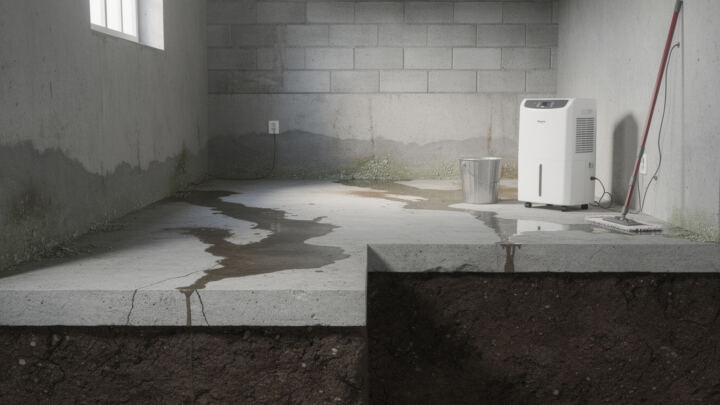
The first time I walked into a basement that felt “off,” it wasn’t dramatic—no puddles, no mini indoor waterfall, nothing like that. It was subtler: a clammy chill underfoot, a stubborn musty odor that didn’t leave even with the windows open, and concrete that looked normal until the light hit it and you noticed those darker patches. My shoes picked up just enough moisture to make me pause. That’s the thing with moisture problems in basement flooring: they often announce themselves through vibe and air before they show up as obvious damage.
In real homes, moisture is rarely a single-source issue. It’s groundwater pressure meeting porous concrete, warm air meeting cold slabs, and everyday living (laundry, storage, showers) adding humidity to a space that already struggles to breathe. If you’re planning to finish a basement—or you simply want it to stop smelling like an old book—understanding how moisture behaves in a basement floor is the difference between quick fixes and fixes that actually stick.
What “Normal” Moisture Content Means for Basement Flooring (and Why It’s Not Just a Number)
When people talk about “moisture content” in a basement floor, they’re talking about how much water is present inside the concrete slab (or in the materials sitting on top of it). Concrete isn’t waterproof; it’s a network of tiny pores. Water can move through those pores as liquid or as vapor, depending on temperature, pressure, and the wetness of the soil below your home’s foundation.
Moisture content is typically expressed as a percentage: the weight of water compared to the weight of the dry material. That sounds technical, but the practical takeaway is simple: you’re trying to figure out whether your slab is dry enough to behave normally—or wet enough to start messing with your space.
In many basements, a typical “healthy” range for slab moisture content sits around 4% to 6%. Once readings creep above 7%, it’s time to stop shrugging and start investigating. And if you see numbers like 10–12%, you’re not dealing with “a little damp basement energy.” You’re dealing with a system that’s actively feeding moisture upward.
Why the “normal range” changes from house to house
Two basements on the same street can behave totally differently. One reason is what’s under the slab. Clay-heavy soil holds water like a sponge and releases it slowly, so slabs above clay often fight a longer battle after rain. Sandy soil drains faster, which can reduce how long the slab stays loaded with moisture.
Construction details matter, too. Newer builds often include a vapor barrier beneath the slab—a plastic membrane designed to block upward vapor migration. Many older homes either lack that barrier or have one that’s incomplete or damaged. That difference alone can explain why one basement feels crisp and another feels permanently damp.
Why you should care even if your basement is unfinished
Moisture isn’t only a finishing-material problem. A damp slab can drive mold growth in boxes, framing, and stored fabrics. It can trigger efflorescence—that white, chalky residue that shows up when water evaporates and leaves salts behind. And it can make the whole space feel colder, because wet air and wet surfaces mess with comfort.
If you’re adding flooring like laminate, engineered wood, carpet, or LVP, moisture becomes even more unforgiving. Adhesives can fail, planks can cup or gap, and underlayment can turn into a hidden sponge. The key insight: you don’t need visible water for basement flooring to fail.
How Moisture Actually Moves Through a Basement Floor: Capillary Action, Vapor Diffusion, and Condensation
Basement moisture problems feel mysterious until you picture the physics. Water doesn’t need a crack big enough to see from across the room. It can rise, spread, and reappear as dampness where you least expect it—especially along edges, control joints, and spots where the slab meets the wall.
Capillary action: the “concrete straw” effect
Capillary action is when water moves upward through tiny pores—kind of like a paper towel soaking up a spill. If the soil beneath the slab is wet, the slab can wick that moisture upward. That’s why a floor can feel cold and slightly wet even if you’ve never had a flood.
This is also why “painting the slab” often disappoints. If moisture pressure continues underneath, coatings can blister or peel. You’re not stopping the source; you’re just putting a thin layer in the way.
Vapor diffusion: moisture as invisible gas
Even when liquid water isn’t traveling, water vapor can migrate from wetter areas (soil under the foundation) to drier areas (your basement air). That movement is slow but steady. Over time, it can keep the slab moisture content elevated and feed that musty smell everyone hates.
This is where a proper vapor barrier—either below the slab (best) or above it as part of a flooring system—can change the whole game. The goal is to control where vapor can go, instead of letting it wander into wood, carpet, or drywall.
Condensation: when “no leak” still becomes wet
Condensation is the classic basement trick: warm, humid air hits a cooler surface (like a slab) and drops water. This is why basements can feel damp in summer. Outside air is muggy, the basement is cooler, and suddenly you’ve got moisture forming on surfaces even without groundwater intrusion.
This is also where ventilation can be a double-edged sword. Bringing in outside air can help in some seasons, but on humid days it can make things worse. The better move is usually controlled air changes plus dehumidification—so you lower humidity without importing more of it.
Once you understand these three mechanisms, you stop chasing random symptoms and start managing the actual pathways that feed basement dampness. Next up: spotting the warning signs before your flooring starts paying the price.
Spotting Basement Floor Dampness Early: 5 Warning Signs Homeowners Miss (and What They Usually Mean)
Most people don’t wake up one day and decide to measure slab moisture. They notice a smell, a stain, or a change in comfort. The trick is learning which signals matter—and what they’re typically pointing to—so you can act while it’s still a manageable fix.
1) Musty, earthy odors that keep coming back
If the smell returns right after cleaning or airing out, it often means moisture is lingering in porous materials or along the slab perimeter. Persistent odor is frequently tied to mold or mildew growing where you can’t easily see it—under stored items, behind finished walls, or beneath flooring layers.
2) Dark patches, damp-looking concrete, or edge wetness
Darkened areas can be a sign of moisture migrating upward or inward from the wall joint. If the edges are worse than the center, that often hints at exterior drainage problems (water collecting near the foundation) or seepage through the cove joint where wall meets floor.
3) Efflorescence: the white chalky “salt dust”
Efflorescence isn’t toxic, but it’s a receipt. It tells you water traveled through concrete, dissolved mineral salts, and left them behind when it evaporated. If you’re seeing it regularly, you’re seeing a recurring moisture pathway, not a one-time event.
4) Flooring damage: buckling, cupping, loose planks, or adhesive failure
Wood and laminate react quickly to moisture imbalance. LVP can look tougher, but adhesives and subfloors still suffer if the slab stays wet. If a finished basement starts failing within months, it’s often because the moisture condition wasn’t tested—or was tested once and then ignored as seasons changed.
5) Measurements that don’t match “normal”
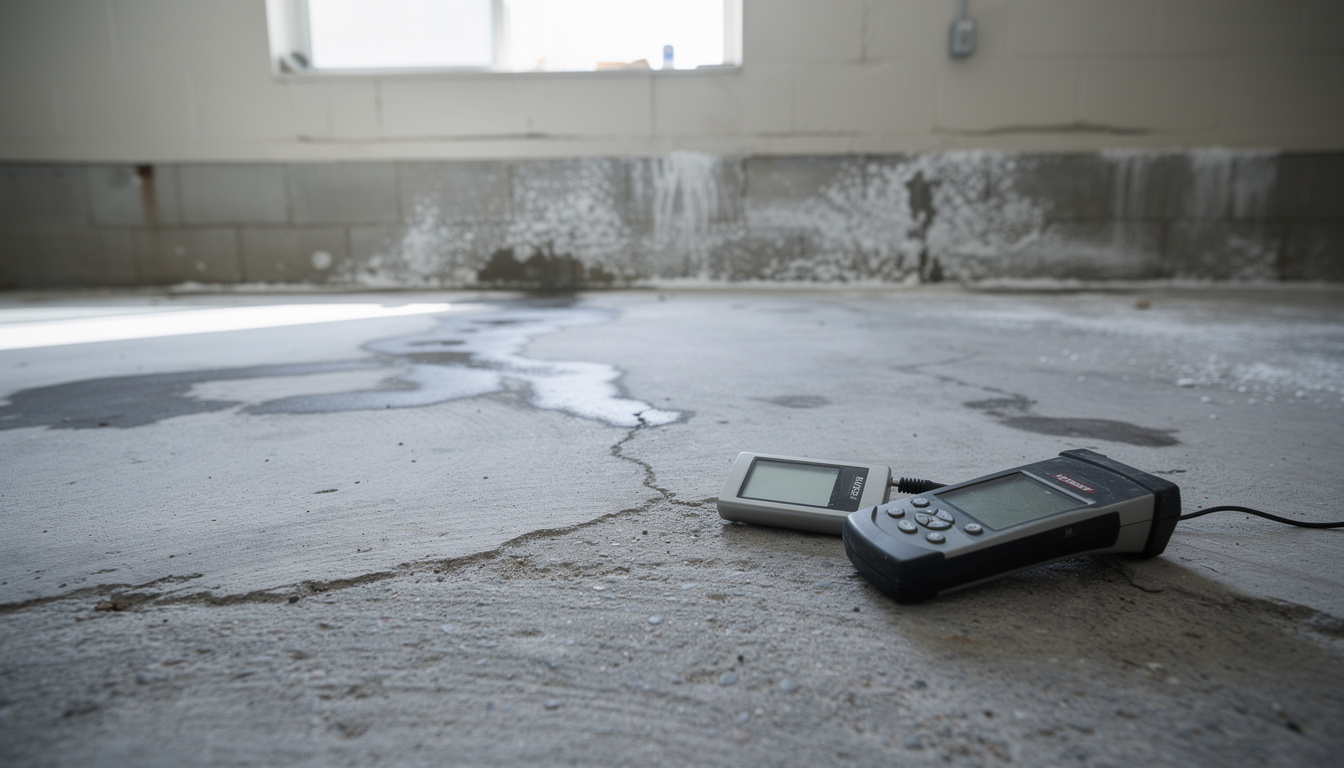
A concrete moisture meter is one of the simplest reality checks you can do. In a small neighborhood project I was involved with, most homes clustered around the mid-range (roughly 5%), but a noticeable slice of basements came in above 8%—and those were the ones where owners also described damp smells and comfort issues. The numbers didn’t create the problem; they confirmed it.
Here’s a practical checklist you can actually use without turning your weekend into a science fair:
- 👃 Smell test: does the musty odor return within 24–48 hours after airing out?
- 👟 Foot test: do socks/shoes feel slightly damp after walking the slab?
- 🔦 Light-angle check: shine a flashlight low across the slab to reveal sheen or patchy dampness.
- 📦 Storage audit: are cardboard boxes soft, warped, or speckled near the floor?
- 🧪 Meter readings: do multiple spots show 7%+ or climb seasonally?
Catch these signals early, and you can often fix causes (drainage, humidity control, sealing) before the repair bill turns into a renovation. Next, let’s talk about measurement and how to interpret what your basement is telling you.
Measuring Basement Floor Moisture the Smart Way: Tools, Sampling Strategy, and a Simple Tracking System
If you only take one reading in the center of the room, you’re basically guessing. Moisture varies across a slab because the edges, cracks, and wall joints act like highways for water vapor and seepage. A smarter approach is to measure like you’re mapping a weather system: multiple points, consistent method, and notes you can compare later.
Choosing tools that match your goal
For homeowners, a concrete moisture meter is a solid starting point. Pros may also use in-slab relative humidity probes or calcium chloride tests, especially when manufacturer specs for flooring warranties demand it. The point isn’t to buy the fanciest gadget; it’s to get repeatable information you can act on.
If you’re installing finished flooring, always check the flooring manufacturer’s moisture limits and testing method requirements. Skipping that step is one of the fastest ways to void a warranty and end up with finger-pointing later.
A step-by-step testing routine that actually works
- 📍 Pick at least 6–10 locations: near corners, along exterior walls, at the center, and at any suspicious patches.
- 🧼 Prep the surface: sweep dust and remove mats so you’re measuring the slab, not debris.
- 🧪 Take readings consistently: same device settings, same contact pressure, same dwell time.
- 🗒️ Record results: note the date, outdoor weather pattern (rain week?), and indoor humidity.
- 📈 Track trends: re-check after big seasonal shifts or major storms.
A table you can use to interpret what you’re seeing
| Reading / Signal | What it often suggests | What to do next |
|---|---|---|
| ✅ 4%–6% (stable) | Normal slab moisture in many basements; low risk for many systems | 🧭 Keep monitoring seasonally; maintain gutters and humidity control |
| ⚠️ 7%–8% (edge-heavy) | Likely vapor migration or perimeter seepage near the foundation wall | 🛠️ Inspect grading, downspouts, cove joint; consider sealing + dehumidifier |
| 🚨 9%–12%+ (widespread) | High moisture load from below; missing/failed vapor barrier or drainage issues | 🧱 Evaluate interior/exterior drainage, sump setup, waterproofing strategy |
| 🌫️ High indoor humidity but slab “looks dry” | Condensation risk on cold surfaces; ventilation missteps possible | 🌀 Control dew point: dehumidify, air-seal, balance ventilation |
A friend of mine—let’s call her Nina—bought a house where the basement “seemed fine” during the winter showing. By late spring, the musty odor showed up, then the area rug started feeling damp. Her readings weren’t crazy in the center (around 6%), but corners hit 9%. That pattern pushed the investigation outdoors, where the downspout was dumping water right at the foundation. Fix the discharge path, and the indoor problem calmed down. The insight: good measurements don’t just confirm dampness—they tell you where to look next.
Now that you can measure and interpret, the big question becomes: what fixes make sense, and which ones are just cosmetic? Let’s get into prevention and repair that lasts.
Basement Flooring Moisture Solutions That Stick: Drainage, Waterproofing, Ventilation, and Material Choices
Basement moisture problems are rarely solved by one magic product. The best outcomes come from stacking defenses: manage water outside, block pathways through the slab and walls, and control indoor air so condensation doesn’t undo your work. Think of it like building a “moisture budget” your basement can actually afford.
Start outside: the cheapest moisture control is often a shovel and a ladder
If rainwater is pooling near your foundation, your basement is basically being asked to hold back a pond. Fixes here are unglamorous but powerful:
- 🏠 Gutters and downspouts: keep them clean and make sure discharge runs far from the house.
- 📉 Grading: soil should slope away so water doesn’t lean on the wall.
- 🧱 Crack and joint inspection: tiny openings can move surprising amounts of water over time.
These steps don’t replace waterproofing, but they lower the amount of water your basement has to fight. Less load means fewer symptoms.
Inside controls: sealing, drainage systems, and smart waterproofing
Sealing cracks with epoxy or polyurethane can help—especially when the crack is a clear entry route. But sealing alone won’t beat hydrostatic pressure forever if water is actively accumulating outside.
For recurring seepage, many homeowners end up considering an interior perimeter drain and sump pump. It’s not a vibe upgrade, but it can be a turning point for a space that keeps cycling between “almost fine” and “gross again.” In one case I worked on, a finished basement showed slab readings around 11% and hardwood started to warp near walls within six months. After drainage improvements, a proper vapor management layer under the new flooring, and consistent dehumidification, readings fell back toward 5% and the odor vanished.
Ventilation and humidity: stop feeding condensation
Basements need air management, not just air movement. If you bring in humid outdoor air during muggy months, you can raise indoor humidity and trigger condensation on cool concrete. A dehumidifier is often the simplest stabilizer, especially when paired with air sealing that reduces moist air infiltration.
Also, watch lifestyle moisture: drying laundry, storing firewood, wet boots, uncovered sump pits. A basement is like a jar—small changes inside can spike moisture fast.
Choosing flooring systems that tolerate basements
This is where a lot of finishing projects go sideways. If a slab is borderline wet, the wrong material will punish you. The safer approach is to pick systems designed for below-grade spaces: vapor-resistant underlayments, appropriate adhesives, and materials that can tolerate occasional swings without warping.
If you love the look of wood, that doesn’t mean “never.” It means you need moisture testing, a vapor control layer, and realistic expectations. Otherwise, you’re betting your flooring budget against physics—and physics is annoying like that.
The lasting insight here is simple: control water at the source, block the pathways, then manage the air. Do it in that order, and your basement stops feeling like a damp science experiment.
What moisture level is considered normal for a basement concrete floor?
Many basements sit around 4%–6% moisture content in the slab. When readings rise above about 7%, it usually signals elevated moisture that can threaten flooring systems, encourage mold, or increase dampness symptoms—especially if the trend worsens seasonally.
Can high humidity cause moisture on basement floors even without leaks?
Yes. High humidity can lead to condensation when warm air meets a cooler slab. That surface moisture can mimic a leak, create musty odors, and contribute to mold risk. Controlling dew point with dehumidification and balanced ventilation is often the fix.
Why does paint peel off a basement floor?
Peeling often happens when moisture vapor pressure pushes from below the slab or when the surface wasn’t prepped for bonding. If the underlying moisture pathway isn’t addressed (drainage, vapor barrier strategy, sealing), coatings tend to fail again.
What are the first waterproofing steps to try before major renovations?
Start with exterior water management: clean gutters, extend downspouts away from the foundation, and ensure grading slopes away from the house. Then seal obvious cracks/joints and add a dehumidifier to stabilize humidity. If moisture readings stay high, consider a drainage system evaluation.
How often should I test basement floor moisture?
If you’ve had no issues, testing every few years and after major water events is reasonable. If you’re planning new flooring or you’ve noticed dampness, test across multiple spots and repeat seasonally to catch trends before damage shows up.