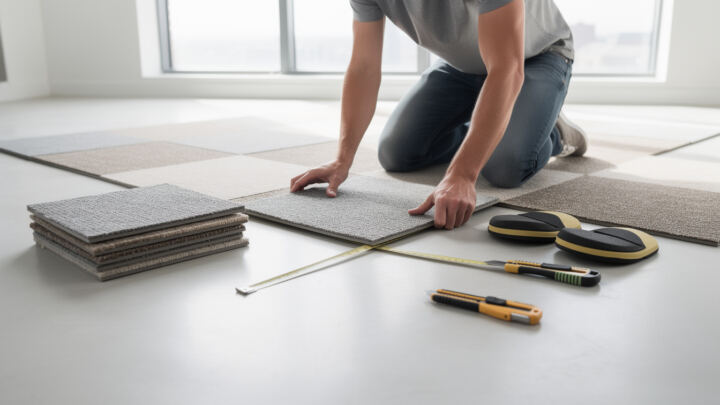
Apartment leases are shorter, home offices keep moving, and design trends turn over faster than ever—so flooring that can keep up is having a moment. That’s why carpet tiles are popping up everywhere from small rentals to busy family rooms: they’re practical, forgiving, and you can swap a single square instead of ripping up an entire floor. If you’ve ever hesitated to commit to wall-to-wall carpet because spills happen (kids, pets, coffee, you… it’s fine), this is the low-drama alternative. The real magic is in the “easy updates” part: rework a pattern, replace worn spots, even move the tiles to a new place if you choose removable tiles or a loose-lay method. And yes—this is a very real DIY win: fewer specialty tools, less mess, and a realistic quick install timeline if you plan it properly.
- 🧭 Plan first: measure the room, sketch a layout, and decide the direction/pattern before you touch adhesive.
- 📏 Start from the center for balanced cuts at the walls (tiny slivers look awkward).
- 🧼 Prep matters: clean, dry, and flat beats “good enough” every time.
- 🧩 Pick the right installation style: peel-and-stick, tape tabs, full spread adhesive, or loose-lay for modular flooring flexibility.
- ✂️ Cut smart: flip, mark, guide with a straightedge, then make light passes with a sharp blade.
- 🔁 Maintenance is the superpower: lift and replace a tile instead of patching carpet.
Choosing Carpet Tiles for Easy Updates: Styles, Backings, and Real-Life Tradeoffs
Not all carpet tiles are created equal, and the “right” choice depends on how you actually live. Here’s a simple way to think about it: you’re buying a system, not just a surface. The face fiber affects how it looks and vacuums. The backing affects how it grips the subfloor. The install method affects whether your easy updates are truly easy—or a sticky chore.
Let’s follow a quick story thread: Maya is redoing a spare bedroom into a combined guest room + work zone. She wants cozy underfoot for Zoom calls, but she also wants to be able to update the look later without hiring anyone. That’s exactly where modular flooring shines: she can do a neutral field now, then swap in a few accent squares later like “throw pillows for the floor.”
Peel-and-stick vs. no-adhesive tiles (and why “more expensive” can be cheaper)
Broadly, you’ll see two common categories: tiles with an integrated peel-off adhesive backing, and tiles that need separate adhesive (tape tabs or glue). Peel-and-stick tends to cost more per square foot, but it can save time and reduce decision fatigue. If your goal is a weekend quick install, peel-and-stick is the fast lane.
No-adhesive tiles can be a great deal, but you’ll need to budget for the attachment method. Some people go with double-sided carpet tape or manufacturer-specific tabs; others choose a pressure-sensitive adhesive that lets you lift tiles later. If you’re aiming for removable tiles in a rental or a space you expect to change often, pay attention to whether the adhesive is rated for releasability.
Design direction: uniform, checkerboard, or “it looks different but I can’t explain why”
Most tiles have arrows on the back that indicate pile direction. If you lay every arrow the same way, you get a smooth, uniform look—clean and hotel-like. If you alternate directions (every other tile rotated 90°), you get subtle shading changes that read as texture. That alternating approach can disguise seams and traffic patterns, which is handy in hallways or home offices with chair wheels.
In Maya’s case, she chooses a mid-tone gray with a heathered pattern. It’s forgiving with lint, and it won’t show every footprint. The key is that her tiles complement the room instead of screaming for attention—because if the floor is loud, every future decor change has to negotiate with it.
Where carpet tile works best (and where you should think twice)
Carpet tile can go over many common subfloors: sealed concrete, plywood/OSB underlayment, some vinyl/linoleum, and even certain hardwoods if the surface is stable and you accept the change. The big “think twice” zones are damp basements without moisture control, floors with active leaks, and soft/uneven surfaces where tiles can telegraph bumps.
Choose with maintenance in mind. If you’ve got pets, look for stain-resistant fibers and low-pile options that are easier to vacuum. For a playroom, cushioning matters more. For a workspace, pick a tight loop or textured cut pile that handles chair movement without looking wrecked after a month. The better you match tile specs to the room, the more those easy updates feel like a power move instead of a rescue plan.
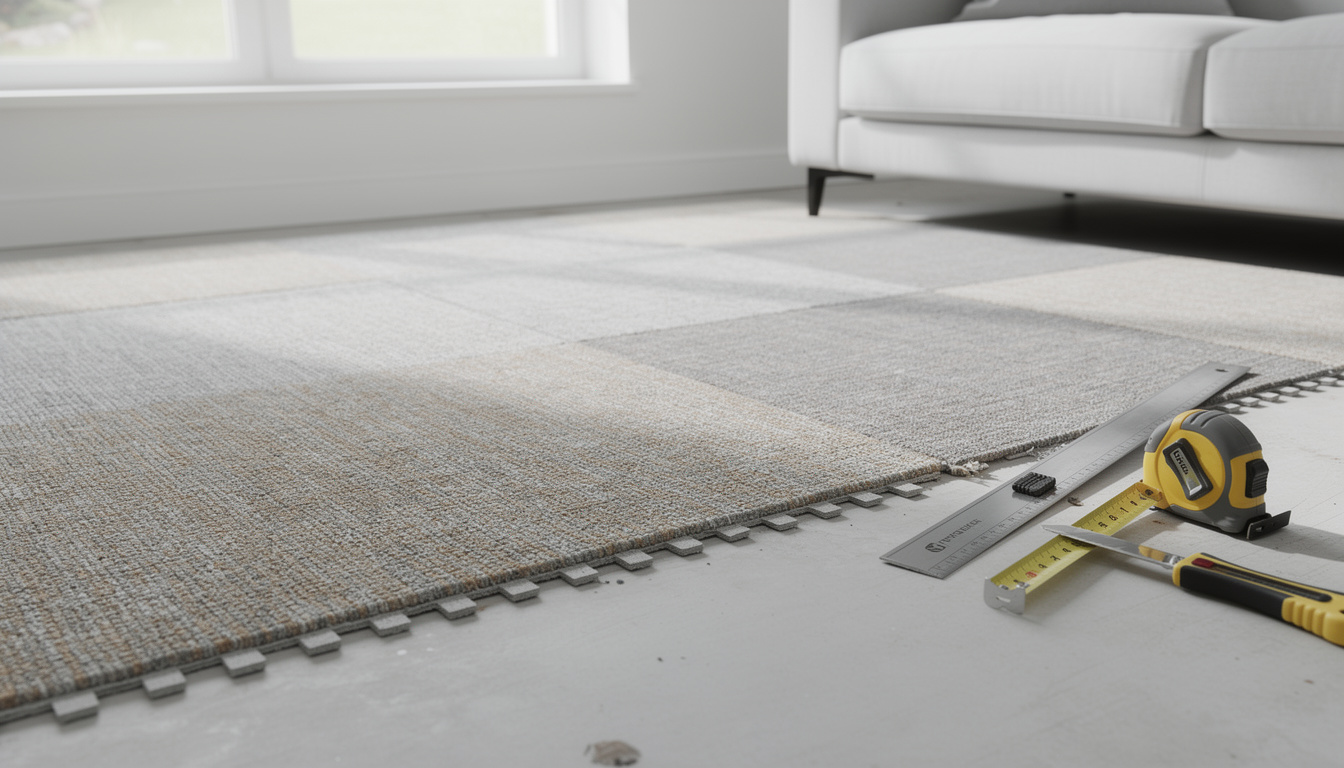
Measure, Map, and Lay Out Carpet Tiles Like a Pro (So the Finished Floor Looks Intentional)
The biggest difference between “DIY that looks pro” and “DIY that looks… DIY” is planning. Carpet tile is forgiving, but it still rewards a layout that anticipates cuts, avoids awkward slivers, and keeps patterns consistent. If you want easy updates later, you also want a layout you can remember and replicate—because nothing’s worse than needing a replacement tile and realizing your original pattern was basically vibes.
Start with measurement. For a rectangular room, multiply length by width to get square footage. For an odd-shaped room, split it into smaller rectangles, calculate each area, then add them up. This isn’t just for buying the right amount; it also lets you decide where the seams and cuts will land. Always buy extra—think of it like spare paint for touch-ups. A small overage covers mistakes, future repairs, and discontinued dye lots.
Sketch a layout (yes, on paper) and why a grid helps your brain
A quick sketch is the cheapest insurance you’ll ever buy. Use graph paper or draw a basic grid and map doors, closets, vents, and any weird jogs in the wall. Lay out your tile direction and pattern on the sketch first. You can even label arrows to keep pile direction consistent.
This is where Maya gets smart: she notices her room is slightly out of square (old house vibes). If she started from one wall, her cuts on the far side would get progressively uglier. Instead, she chooses a center-start method so any “old house math” gets distributed evenly around the perimeter.
Find the center lines: your best friend for balanced borders
To find the center reference, measure to the midpoint of one wall, mark it, then snap or draw a chalk line across the room. Repeat for the adjacent wall so the lines intersect at the room’s center. That cross is your launch point. It helps you keep the field square, and it gives you symmetry in border cuts.
For irregular rooms, treat each zone as its own shape and establish a center line that makes sense for the main visible area. A closet alcove doesn’t need to dictate the whole layout.
Dry-fit first: place tiles without adhesive and adjust for “no tiny strips”
Before sticking anything down, dry-lay four tiles around the center point—one in each quadrant—with edges aligned to your chalk lines. Then build outward, snugging each tile to its neighbor. Work quadrant by quadrant. This dry-fit does two things: it confirms your tile count and it reveals how your perimeter cuts will look.
If you see that one side is going to end with a skinny 1–2 inch strip, don’t accept it. Shift the whole layout slightly (move the center cluster left/right or up/down) until the border pieces are a healthier size. As a rule of thumb, avoid anything under about 4 inches (10 cm) unless the space is hidden behind a door swing or baseboard return. This one tweak is a visual game-changer and makes the final installation look deliberate.
Once your dry-fit looks good, take photos from a few angles. It sounds silly, but it’s gold later when you’re doing maintenance or swapping in accent squares for easy updates.
Surface Prep for Carpet Tile Installation: Clean, Flat, Dry, and Drama-Free
If carpet tile fails, it’s usually not because the tile was “bad.” It’s because the floor underneath was dirty, dusty, damp, or bumpy. Prep isn’t the glamorous part of home improvement, but it’s the part that decides whether your DIY floor feels solid underfoot or starts shifting at the seams.
Start simple: vacuum thoroughly, then wipe the surface with a damp mop or rag to pick up fine dust. Let it dry completely. Dust is sneaky—on a hard surface it can look clean, but it acts like ball bearings under adhesive. The cleaner the floor, the more consistent the bond (or friction hold, for loose-lay setups).
Subfloor checklist by material: concrete, vinyl/linoleum, hardwood
Concrete: Make sure it’s sealed or at least not actively shedding dust. If moisture is a concern (common in basements), do a basic moisture check per product guidance. Persistent dampness can lead to odor or adhesive problems, and no tile pattern can hide that.
Vinyl/linoleum: Many tiles can go right over it if it’s well-adhered and flat. Clean off any waxes or polishes. If the vinyl is peeling or heavily textured, you’ll likely need to smooth or repair first so the texture doesn’t telegraph through.
Hardwood: Stable hardwood can work, but you’re making a choice: adhesive may pull finish later, and even removable systems can leave marks. If you’re protecting nice hardwood, consider a barrier layer or use a method designed for removable tiles.
Tools that make the job calmer (and safer)
You don’t need a truckload of gear, but a few basics matter. A sharp utility blade is non-negotiable; dull blades cause frayed edges and sloppy cuts. A straightedge (or level) keeps lines true. A measuring triangle helps with right angles around door jambs and trim.
- 🧹 Vacuum + damp mop/rag (dust control)
- 📏 Measuring tape (accurate square footage and gaps)
- 📐 Level or straightedge + measuring triangle (clean cut guides)
- ✂️ Utility knife with fresh blades (clean edges)
- 🖊️ Pencil/pen + paper (layout, notes, tile direction)
- 🧷 Tape tabs or adhesive/glue (depending on your installation plan)
When “loose-lay” is actually the smarter move
There’s a reason “install carpet tiles without glue” tutorials are popular: in low-traffic rooms, the weight of the tiles and tight fit can be enough—especially if furniture anchors the field. Loose-lay can be perfect for renters or anyone who loves seasonal changes. The tradeoff is that edges and transitions need more attention, and you’ll want to avoid rolling office chairs unless you add chair mats or a more secure adhesive system.
Maya decides on a hybrid: she uses releasable adhesive tabs at corners (enough to keep everything aligned) so she can still lift and replace squares during maintenance. That choice keeps her floor flexible and her future updates genuinely easy.
With prep handled, you’re ready for the part everyone actually wants: cutting, sticking, and watching the room transform fast.
Step-by-Step Carpet Tile Installation: Center-Out, Tight Seams, and Clean Press-Down
The actual installation is where your planning pays you back. The goal is a tight grid with seams that practically disappear, and a surface that feels stable. Work methodically, don’t rush corners, and keep checking alignment against your reference lines.
Dry-fit to final: keep your pattern and direction consistent
Return to your centered cross and confirm the arrows on the back of each tile. Decide whether you’re doing uniform direction (all arrows the same) or alternating direction for a textured look. Once you commit, stick to it. Mixed direction can look like a mistake unless it’s an intentional pattern.
Begin by placing the four center tiles. Then fill each quadrant outward, placing each tile snugly against the last. If you’re using adhesive-backed tiles, don’t peel everything at once—do it in manageable sections so you can correct alignment without panic.
Adhesive options: peel-and-stick, tape tabs, or glue
Peel-and-stick: Peel the protective film, press the tile into place, and apply firm pressure. It’s straightforward and great for a quick install, but you still want accuracy—sticky backings are not forgiving if you slap them down crooked.
Tape tabs / double-sided tape: Apply tabs to corners or along edges based on the system. This is popular for modular flooring where you want some removability. It’s also less messy than wet adhesive.
Carpet tile adhesive (pressure-sensitive): Spread per manufacturer instructions (often with a specific trowel), allow proper tack time, then set tiles. This is common in higher-traffic rooms where shift resistance matters. Many pressure-sensitive products still allow tile replacement later, which keeps easy updates on the table.
Cutting perimeter tiles: measure the gap, flip, mark, slice in passes
When you reach a wall, measure the gap between the last full tile and the wall. Flip a tile upside down, mark the measurement on the back, and draw a straight cut line using a straightedge. Place the tile on scrap cardboard or a spare piece of carpet to protect what’s underneath.
Use a utility knife to score lightly a couple times, then increase pressure to cut through. This “multiple passes” technique gives cleaner edges and helps avoid overcutting. Fit the cut piece into the gap and check for a snug finish. If it’s too tight, trim a hair at a time—tiny adjustments beat ruining a tile with one aggressive cut.
A visual tip: if you notice you’ll end up with border strips narrower than about 4 inches, revisit your center offset before committing. Balanced borders make the whole floor look calmer, especially in small rooms where every edge is noticeable.
Press-down and final alignment: treat seams like you mean it
Once tiles are placed, press them down firmly by hand, especially at edges and corners. In busy spaces, you can use a floor roller if you have one, but careful hand pressure works for most home DIY jobs. Watch for “peaking” seams where corners lift slightly—usually a sign of debris, uneven floor, or a tile that’s not fully seated against its neighbor.
| ✅ Goal | 🔧 What to do | 🧠 Why it matters |
|---|---|---|
| 🧩 Tight seams | Butt tiles firmly; align to center lines | Seams disappear and the grid stays stable |
| 📐 Straight field | Check every few rows against chalk lines | Prevents “drift” that creates ugly perimeter cuts |
| ✂️ Clean borders | Measure gaps, flip tile, cut with straightedge | Edges look intentional, not patched |
| 🧼 Easy replacements | Use releasable adhesive where appropriate | Better maintenance and true easy updates |
Once everything is down, walk the room slowly. Feel for shifting, listen for crunching (dust under tile), and look at seams under different light. That last check is where a good job becomes a great one.
Easy Updates and Maintenance with Modular Flooring: Replacing Tiles, Cleaning Hacks, and Long-Term Looks
This is where carpet tile earns its reputation. Traditional carpet is basically “all or nothing.” With carpet tiles, you can treat your floor like a set of components. Spill a smoothie? Replace two squares. Sun-faded patch by the window? Swap a few tiles and rotate others. Want a new vibe for spring? Rework the border color. That’s the whole point of modular flooring: the floor evolves with you.
How to replace a single tile without making it obvious
First, identify the exact tile(s) to replace. If you installed with peel-and-stick or glue, lift carefully using a putty knife-like motion (without gouging the subfloor). If you used tabs or a loose-lay approach, removal is simpler. Clean any residue and ensure the surface is dry.
Here’s the trick Maya uses: she saves a few leftover tiles and stores them flat in a closet, labeled with the room name and arrow direction. When she replaces one, she matches pile direction so the shading doesn’t shift. If she’s using an older spare that looks slightly different due to age, she “blends” by moving a few tiles around—put the freshest one in the most visible spot and move slightly older ones to less obvious areas (like under the bed). That approach makes updates invisible.
Cleaning routines that keep tiles looking new (without babying them)
Most of the time, regular vacuuming is enough. Use a vacuum appropriate for your pile type; aggressive beater bars can fuzz certain fibers. For spills, blot first, don’t rub—rubbing pushes stains deeper and roughs up the texture. Mild carpet cleaner works, but test on a spare tile if you’re using anything strong.
For high-traffic zones (desk chair paths, entry points), rotate tiles occasionally if your system and layout allow it. Rotating spreads wear and keeps the “track” pattern from permanently setting in. It’s the flooring equivalent of rotating a mattress—simple, not glamorous, but effective.
Design updates: borders, runners, and “zone” layouts
One of the most satisfying easy updates is adding a visual zone without adding a rug. For example, you can create a “runner” path from the door to the sofa using a darker shade, or frame a desk area with a contrasting border. This is especially useful in open-plan rooms where you want subtle separation without building walls.
Maya does a smart move: she keeps the main field neutral, then creates a 2-tile-wide border in a deeper tone around her desk area. It makes the workspace feel intentional and hides inevitable chair scuffs. Later, if she repaints the room, she can swap only the border color instead of the whole floor.
When to re-stick vs. fully redo
If tiles start to creep apart, it’s often a perimeter issue or a traffic pattern pulling at seams. Re-press the tiles, check for debris, and add tabs at strategic corners. If a whole section is shifting, you may need a more secure adhesive in that zone (like under a rolling chair). The nice part is you can strengthen attachment in problem areas without tearing out the entire floor.
That’s the long-term win: carpet tile is forgiving, but it still rewards a little attention—small fixes now prevent big repairs later.
Can I install carpet tiles over existing linoleum or vinyl flooring?
Usually yes, as long as the surface is flat, well-bonded, and cleaned of dust, oils, and any polish/wax residue. Dry-fit first to confirm the floor texture won’t telegraph through, and choose an installation method (tabs, peel-and-stick, or pressure-sensitive adhesive) that matches your need for removability.
Do I have to start in the center of the room?
Center-start is the easiest way to get balanced border cuts and keep the grid square, especially in older rooms that aren’t perfectly square. If you start from a wall, small alignment errors can drift and show up as ugly skinny cuts on the far side.
What’s the easiest way to cut carpet tiles cleanly?
Flip the tile, mark the measurement on the back, use a straightedge as a guide, and cut with a sharp utility knife in multiple light passes. Put scrap cardboard or spare carpet underneath so you don’t damage the floor, and test-fit before trimming more.
Are removable tiles actually secure enough for daily life?
In low-traffic rooms, a tight dry-fit plus furniture weight can work well. For active spaces, use releasable adhesive tabs or a pressure-sensitive adhesive so tiles stay aligned but can still be replaced for maintenance and easy updates.
How many extra carpet tiles should I buy?
Buy extra for cuts, mistakes, and future maintenance. A practical target is enough to replace a few high-traffic tiles later and still match color and texture, since product lines can change over time.