
In 2026, radiant heating isn’t just a “nice-to-have” splurge for spa bathrooms anymore—it’s showing up in basements, sunrooms, kitchens, and even RV renovations. And here’s the catch: the warm-floor dream can turn into a lukewarm reality fast if your flooring selection fights your system instead of working with it. The floor you walk on becomes part of the heating system, basically acting like a “lid” that either lets warmth pass easily or traps it underneath. That’s why people get confused when a box says “radiant-heat compatible” but doesn’t explain what that actually means. Are you paying for a label, or are you getting real performance?
The best results come from matching flooring materials to your system type (hydronic vs electric), your room’s use, and your expectations around thermal comfort. Tile might heat like a champ but feel too hard in a playroom; vinyl plank might look perfect and handle water, but some versions need strict temperature regulation. Add in adhesives, underlayment thickness, and warranty fine print, and it’s easy to see why installers sometimes default to whatever they know (or whatever is pricey). Let’s make it practical: what transfers heat well, what lasts, what’s easy to install, and what pitfalls are worth avoiding.
En bref
- 🔥 Prioritize heat conductivity (and low thermal resistance) so your system doesn’t waste energy pushing warmth through an insulating floor.
- 🧱 Tile and stone deliver top-tier heat transfer and stable performance for underfloor heating, especially in bathrooms and kitchens.
- 🪵 Engineered wood can work beautifully with radiant systems if you respect plank thickness, moisture control, and gradual warm-up settings.
- 🧩 Luxury vinyl plank (LVP) is a popular “real-life” choice, but you need radiant-approved specs and careful flooring installation details.
- ⚡ Electric mats are great for targeted comfort; hydronic systems shine for whole-home energy efficiency.
- 🛠️ Layout planning, sensor placement, and impedance checks can prevent expensive rip-outs later.
- ✅ Don’t ignore the boring stuff: manufacturer temperature limits, underlayment type, and adhesive ratings matter a lot.
Selecting Flooring That Complements Radiant Heating: Start With the System, Not the Showroom
If you want your radiant heating to feel amazing, start by thinking like a builder, not a shopper. Your floor isn’t just décor—it’s a functional layer that controls heat transfer, response time, and how evenly warmth spreads. That’s why two homes with the “same” heating mats can feel totally different once the finished surface goes down.
Let’s follow a simple storyline: Mia and Jordan buy a 1990s house with a cold basement office and a sunroom that never gets enough air from the furnace. Sound familiar? They decide on underfloor heating because forced air is noisy, dusty, and doesn’t solve chilly floors. The big decision becomes flooring selection: do they pick the look they want and hope it works, or match materials to performance?
Hydronic vs Electric Radiant Heating: Why It Changes the Flooring Conversation
Hydronic systems circulate warm water through tubing. They’re often the kings of whole-house energy efficiency because water carries heat effectively and can run at lower temperatures. Hydronic also tends to be more forgiving with larger spaces, but it’s harder to retrofit in one small room without opening a lot of structure.
Electric systems use cables or mats, and they’re popular for bathrooms, basements, and remodels. They heat up faster, which people love when they’re chasing comfort on winter mornings. The tradeoff is operating cost can be higher depending on electricity rates, so the flooring should avoid “insulating” the heat away.
There’s also air-based radiant, but it’s rare for a reason: air doesn’t hold heat like water, so performance tends to be underwhelming for primary heating.
Thermal Comfort Isn’t Just Warm—It’s Even Warm
People think radiant equals “hot floor,” but the real goal is thermal comfort: steady warmth, no cold corners, no drafts. That depends on how your floor spreads heat sideways as well as upward. Dense surfaces (like porcelain tile) help “even out” the temperature across the room. Softer or layered materials can create warm stripes directly over heating runs and cooler gaps between them.
And yes, temperature regulation matters. A floor sensor + smart thermostat can keep the surface within manufacturer limits, protect vinyl from warping, and prevent that weird overheated feeling near the edges of mats.
A Quick Reality Check on Savings
Radiant systems can reduce wasted energy because you’re heating people and surfaces from the ground up. The U.S. Department of Energy has long cited savings that can reach around 25% compared to certain conventional approaches, especially when the building envelope is decent and your flooring doesn’t block heat. That “when” is doing a lot of work: the wrong top layer can erase the advantage.
Next up, let’s get into the part everyone argues about at the flooring store: which flooring materials actually play nice with radiant heat in daily life.
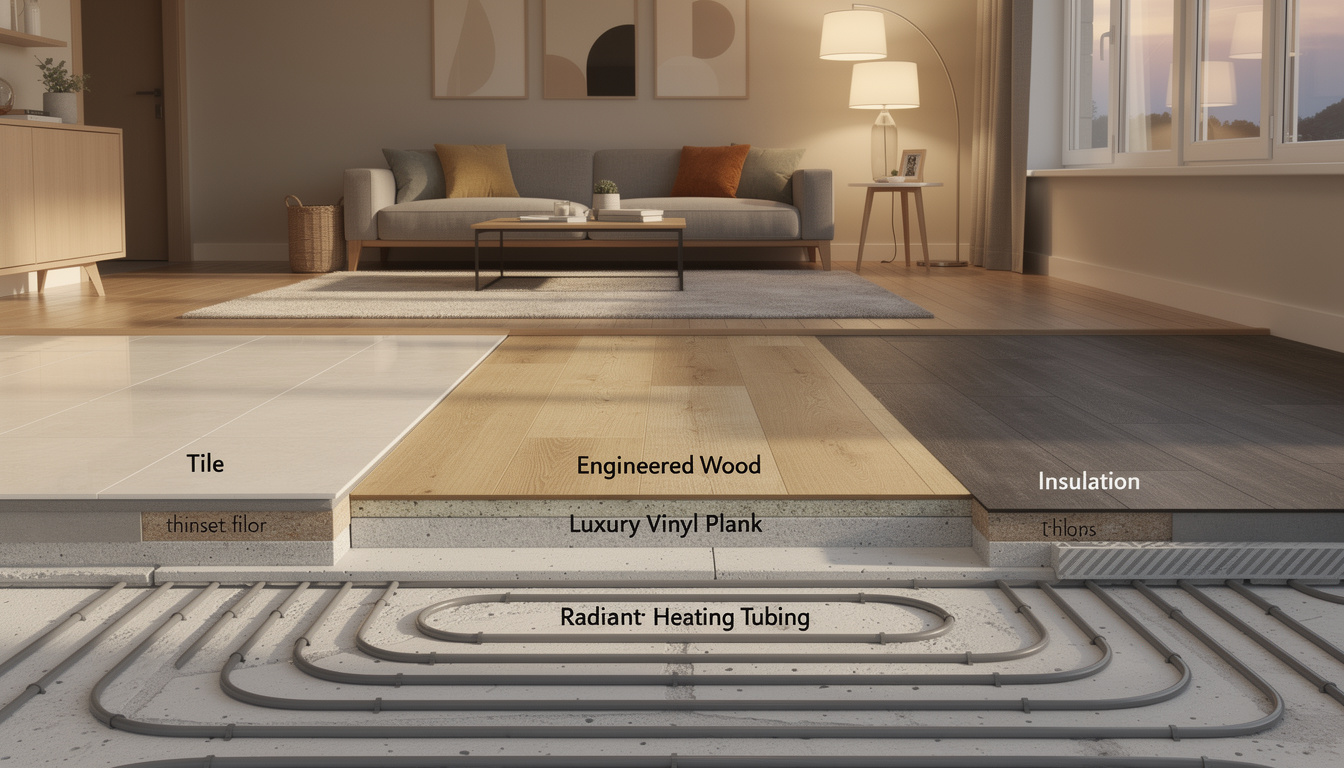
Best Flooring Materials for Radiant Heating: Heat Conductivity vs Real-World Living
If you only remember one thing, make it this: your floor is either helping or hurting heat conductivity. High conductivity means the warmth moves through fast and spreads well. Low conductivity means longer warm-up times, higher thermostat settings, and sometimes that nagging feeling that your system “isn’t that great.”
Mia and Jordan shortlist three surfaces that show up again and again in 2026 installs: tile, engineered wood, and luxury vinyl plank. Each one can work—but each one has rules.
Tile and Stone: The Performance Benchmark for Heat Transfer
Tile (ceramic or porcelain) and natural stone are basically the gold standard for underfloor heating. They’re dense, stable, and excellent at heat transfer. When the heating mat warms the substrate, tile absorbs that energy and radiates it evenly. That’s why bathrooms with radiant tile feel like luxury even if the room air is only a couple degrees warmer.
Tile is also practical: water, mud, pets, winter boots—no panic. The “con” is comfort underfoot if you don’t like hard surfaces. A workaround is using washable runners strategically, but remember thick rugs can reduce heating performance.
Engineered Wood: Warm Look, Smarter Structure
Solid hardwood can be tricky over radiant because wood expands and contracts with temperature and humidity swings. Engineered wood is more stable because it’s layered, so it tolerates controlled heat better. You still need to respect manufacturer limits, and plank thickness matters: thicker boards slow response time.
In practice, engineered wood is a great pick for living rooms and bedrooms where you want a warmer look but don’t want to give up the comfort of radiant. The key is using gradual ramp-up settings and avoiding huge, sudden temperature jumps that stress the wood.
Luxury Vinyl Plank (LVP): The “Looks Great, Works If You’re Careful” Option
Luxury vinyl plank is everywhere because it’s durable, water-resistant, and easy to clean. But not all vinyl is created equal. The stuff designed for radiant applications usually has a better core structure and published specs for max surface temperature.
Vinyl can expand or soften if overheated, so temperature regulation isn’t optional—it’s the whole game. Done right, LVP can be a super practical match for basements (where concrete slabs feel cold forever) and for busy households that want scratch resistance.
Mia installs radiant mats under LVP in the basement office. The floor doesn’t feel instantly hot; it takes a bit to warm up. But once it reaches setpoint, the comfort is steady and the room finally feels usable without a space heater. That “slow to warm, easy to maintain” vibe is common with layered floors.
Comparison Table: Choosing Flooring for Radiant Heating at a Glance
| Flooring type | Heat conductivity & transfer | Comfort & durability | Watch-outs |
|---|---|---|---|
| Tile / Stone 🧱 | Excellent 🔥 (fast, even) | Very durable ✅, hard underfoot | Needs proper substrate; grout/uncoupling choices matter |
| Engineered wood 🪵 | Good 👍 (steady, moderate speed) | Warm look ✅, stable if rated | Respect max temps; humidity control; avoid rapid swings |
| LVP (radiant-rated) 🧩 | Fair-to-good 🙂 (depends on thickness/core) | Waterproof ✅, scratch resistant | Overheating risk; adhesive/underlayment must be compatible |
| Carpet (thick) 🧶 | Poor ❄️ (insulates heat) | Soft ✅ | Reduces efficiency; longer run times and higher costs |
Now that the material side is clear, the next make-or-break factor is the part most people underestimate: flooring installation details and how the heating product itself is chosen.
Want a quick visual of different radiant systems under finished floors? This walkthrough-style video search helps.
Flooring Installation for Underfloor Heating: Layout Planning, Sensors, and the Stuff That Prevents Regrets
The most expensive radiant floor is the one you have to rip out because a wire got nicked, the thermostat sensor is in a bad spot, or the floor floats and squeaks because the sublayer wasn’t flat. A good flooring installation plan is part engineering, part patience.
Let’s keep following Mia and Jordan as they do two zones: a basement office over concrete and a kitchen remodel with tile. They pick electric mats for both because it’s a retrofit. The “secret sauce” becomes planning the layout before a single plank or tile goes down.
Pre-Installation Checklist That Actually Helps
- 📏 Map the room and keep heat elements out from under permanent cabinets, tubs, and vanities to avoid trapped heat and wasted watts.
- 🧠 Plan wire routing so it doesn’t create bumps under floating floors; shallow channels in underlayment can keep everything flush.
- 🧰 Keep a multimeter handy and test resistance/impedance during steps of the install to catch damage early.
- 🌡️ Use a floor sensor for temperature regulation so you protect vinyl/wood limits while maintaining comfort.
- 🧱 Make the subfloor flat and clean; lumps and debris can telegraph through LVP and create pressure points.
- 🧻 Protect mats with cardboard or ram board while you work so tools and boots don’t scar the system.
Floating Floors vs Glue-Down: How the Method Changes Heat Behavior
Floating floors (common with LVP click-lock and some engineered wood) sit on an underlayment. This can be great for DIY and for future repairs, but thick or spongy underlayments reduce heat transfer. For radiant projects, thin, dense underlayment is usually the smarter call.
Glue-down installs can improve contact with the heated substrate, but adhesives must be rated for radiant conditions. Some glues soften at higher temps; that’s when planks shift, edges lift, and you get that “why is my floor separating?” nightmare.
Anecdotes from Popular Heating Mat Setups (and What They Teach)
Some homeowners love programmable systems built specifically for floating floors because they can pair laminate, wood, or LVP with a heating layer designed not to create hot spots. One basement case is classic: cold slab, three chilly rooms, and forced-air that never quite reaches the edges. With a programmable thermostat, the space becomes usable year-round, and the system doesn’t necessarily spike the bill the way people fear—especially when you run it on a schedule and let the floor “coast” midday.
Other installs highlight the fussy part: routing wires through grooves in underlayment and protecting them at wall transitions. It’s not glamorous, but it’s what prevents pinched cables and future shorts. One clever move that keeps showing up is using protective covers where wiring rises into the wall, plus frequent resistance checks as flooring goes down.
And yes, mistakes happen. A cut wire during a toilet supply install is the kind of accident nobody plans for. The difference is whether the brand has repair guidance and responsive support—and whether you documented readings before and after the incident. That paper trail can save you days.
Electric Load Planning: The “Hidden” Part of Comfort
Radiant mats draw real power, and multiple zones add up. Before you fall in love with a layout, confirm the circuit capacity and total amperage so you don’t trip breakers every morning. In larger installs, Wi‑Fi thermostats can help you stagger schedules and track usage, which supports energy efficiency without sacrificing comfort.
Next, let’s talk about shopping: product claims, what “radiant compatible” should mean, and how to compare options without getting played by marketing.
If you’re curious about common installation steps and wiring best practices, this video search is a handy companion while you plan your project.
I Tested And Reviewed 7 Best Vinyl Plank Flooring For Radiant Heat: What to Look for Beyond the Label
The phrase “best vinyl plank flooring for radiant heat” gets thrown around a lot, but the smarter approach is: pick vinyl that’s truly compatible with your system and your lifestyle. LVP is popular because it’s tough, water-friendly, and easier to install than tile. Still, it can underperform if you choose a thick, insulating build or ignore the temperature limits.
Here’s a practical way to think about it: you’re not only buying planks. You’re buying a stack-up—subfloor + heating layer + underlayment (maybe) + vinyl. Every layer affects heat conductivity and overall thermal comfort.
Seven Commonly Chosen Products (Heating + Flooring) and Where They Fit
Below is a curated set of products that homeowners frequently use when pairing floating floors or hard surfaces with radiant systems. Some are heating mats designed for floating floors, and one is a DIY-friendly interlocking LVP option that people like for quick transformations.
| # | Product | Best use case | What to pay attention to |
|---|---|---|---|
| 1️⃣ | FloatMat (programmable radiant heating for floating flooring) | Laminate/wood/LVP floating floors in cold rooms 🧊➡️🔥 | Warm-up time, thermostat placement, flatness of the base |
| 2️⃣ | QuietWarmth LuxeMat (wood/laminate heating mat) | Floating floors where you want thin mats and predictable zones ✅ | Wire routing grooves, impedance checks, protect mats during install |
| 3️⃣ | LuxHeat electric system with alarm | Tile/stone/laminate zones with extra monitoring 🛡️ | Programming, sensor setup, verify install to avoid false issues |
| 4️⃣ | Lucida Interlock Vinyl Planks (10 planks, ~24.5 sq ft) | DIY wood-look LVP updates 🧩 | Confirm radiant compatibility; use the right underlayment to avoid insulation |
| 5️⃣ | FloorLace FIT self-adhesive heating mat | Bathrooms/kitchens under tile/laminate/stone ✨ | Subfloor prep, dry-fit layout, avoid overlaps, protect leads |
| 6️⃣ | FloatHeat QWARM3X10F240 (floating floor radiant heat) | Large floating-floor projects with multiple mats 🏔️ | Electrical planning, wire management, thermostat controls, underlayment choice |
| 7️⃣ | LuxHeat 20 sq ft mat kit | Smaller rooms and targeted comfort zones 👣 | Voltage confirmation, multimeter testing, repair procedure knowledge |
How to Judge Vinyl for Radiant Heat (Without Guessing)
When you’re evaluating LVP for a heated floor, check for published limits and construction details. Marketing phrases are cute, but you want specs.
- 🌡️ Maximum allowed surface temperature: Many products cap around the low-to-mid 80s °F; stay within the manufacturer limit to avoid warping.
- 🧱 Core type and thickness: A rigid core can help stability, but too much thickness can slow heat transfer.
- 🧪 Warranty language: Some warranties require a floor sensor and gradual temperature changes.
- 🧴 Adhesive rating (if glue-down): Use radiant-approved adhesive to avoid softening and plank movement.
- 🧩 Underlayment choice: Thick foam can act like a winter coat for your heating system—cozy for the floor, terrible for efficiency.
Cost vs Performance: The “Cheap Now, Expensive Later” Trap
People often choose the cheapest plank they can find, then crank the thermostat when the room feels cool. That’s when operating costs creep up and the system starts cycling longer. A better strategy is to buy a radiant-rated LVP that balances durability with decent heat conductivity, then pair it with smart scheduling so you’re not heating an empty room all day.
Next, we’ll tackle the risks people worry about—warping, adhesive failure, efficiency loss—and how to avoid them with sensible controls and maintenance habits.
Radiant Heating + Vinyl Plank Flooring: Risks, Temperature Regulation, and Maintenance That Keeps It Looking New
Vinyl plank over radiant heating can be awesome, but it’s not “set it and forget it” unless you set it up correctly. The common concerns are real: overheating, expansion/contraction, adhesives softening, and the system feeling less effective because vinyl can behave more like an insulator than tile.
The good news is that most failures come from a few predictable mistakes—meaning they’re preventable.
Overheating and Expansion: Why Control Beats Power
Vinyl responds to temperature changes. If the surface gets too hot, planks may expand, edges can crown, or joints can stress. That’s why temperature regulation with a floor sensor is such a big deal. Instead of blasting heat, you’re maintaining a stable range. This is also how you protect your investment if you plan to sell later—buyers love heated floors, but they hate visible flooring issues.
A practical habit: increase temps gradually, especially after vacations or power outages. Sudden jumps are where materials get cranky.
Efficiency Loss: When the Floor Becomes a Blanket
Vinyl’s layered structure can slow heat transfer compared to tile. That doesn’t mean it’s a bad choice; it means expectations should be realistic. In a basement office, you might aim for warm feet and steady comfort rather than using the floor as the sole heat source on the coldest nights.
Also watch what you put on top: dense rugs with thick pads can trap heat underneath. If you love rugs, pick thinner ones and keep them smaller so heat can still radiate into the space.
Cleaning and Maintenance: Keep It Simple (and Skip the Steam Mop)
With heated vinyl floors, gentle cleaning wins. Use manufacturer-approved cleaners, sweep often, and mop with a wrung-out damp mop rather than soaking the surface. Steam mops are a common “quick clean” tool, but heat + moisture + pressure can be rough on seams and finishes over time.
Spills should be wiped quickly so moisture doesn’t migrate into edges or underlayment. And every so often, take a look at thresholds and transitions—those areas show early signs of movement if anything is off.
Small Habits That Improve Thermal Comfort
- ⏰ Run schedules that pre-warm before morning routines, then coast midday for better energy efficiency.
- 📍 Place sensors away from sun patches so direct sunlight doesn’t confuse the thermostat.
- 🚪 Use door drafts and window coverings to reduce heat loss—radiant feels best when the room envelope is decent.
- 🧊 In basements, consider a moisture barrier if recommended; damp slabs can undermine comfort and stability.
At this point, you’ve got the big picture: choose the right material, install it intelligently, and control temperatures like a grown-up. Below are a few practical Q&As that come up constantly when people combine vinyl or other modern floors with radiant systems.
Can vinyl plank flooring be installed over radiant heating without an extra underlayment?
Often yes, but it depends on the vinyl product and the heating system. Many radiant-approved LVP floors work best with a thin, dense underlayment (or none at all) so heat transfer isn’t blocked. Always follow the flooring and heating manufacturer instructions, because the wrong underlayment can reduce efficiency and may affect warranty coverage.
What’s the biggest risk when pairing vinyl plank flooring with underfloor heating?
Overheating is the main risk. Vinyl can expand, soften, or warp if the surface temperature exceeds the manufacturer limit. A thermostat with a floor sensor for temperature regulation is the easiest way to keep the floor safe while still getting great thermal comfort.
Does vinyl plank reduce energy efficiency compared to tile?
Usually, yes—tile and stone typically deliver better heat conductivity and faster heat transfer. Radiant-rated LVP can still perform well, but it may warm more slowly and sometimes needs longer run times. The difference is often manageable if your system is well-designed and you avoid thick underlayments and heavy insulating rugs.
Are there special flooring installation steps I shouldn’t skip for radiant heat?
Don’t skip subfloor flattening, layout planning, and electrical testing. Keep heating elements out from under permanent fixtures, route wires so they don’t create bumps, and measure resistance/impedance during install to catch damage early. Those steps prevent expensive tear-outs and protect long-term performance.
How should I clean vinyl plank floors installed over radiant heating?
Use manufacturer-approved cleaners, sweep or vacuum regularly with a soft attachment, and damp-mop with minimal water. Avoid abrasive products and skip steam mops, since heat plus moisture can stress seams and finishes. Wipe spills quickly and keep an eye on transitions and edges for early signs of movement.