There’s a reason ceramic tiles keep showing up in renovations, from tiny city bathrooms to big open-plan kitchens: they look sharp, they handle real life, and they age way better than most “quick upgrade” materials. But the part nobody posts on social media is that great-looking tile isn’t luck—it’s the result of boring-sounding choices made early: floor preparation, a smart tile layout, and doing the unglamorous stuff (like cleaning, leveling, and waiting) when you’d rather see finished results. If you’ve ever stepped on a tile that clicks, noticed grout lines wandering like a bad haircut, or seen corners chip within months, you’ve already met the consequences of skipping fundamentals.
Let’s follow a simple thread: a fictional DIYer named Maya, renovating a 1980s mudroom that takes daily abuse—wet shoes, dog traffic, and winter grit. Her goal isn’t just “installed tile,” it’s tile installation that feels solid underfoot and stays crisp-looking for years. Along the way you’ll see how pros think about reference lines, mortar consistency, spacing tiles without drift, and why grouting is more like finishing carpentry than it is “filling gaps.” If you want pro results, the good news is you don’t need mystical talent—just a process you actually stick to.
- 🧭 Plan the tile layout first so cuts land in the right places (no skinny “sliver tiles”)
- 🧱 Floor preparation decides everything: flat, clean, stable, and moisture-safe
- 🪣 Mix mortar to a workable texture and only in batches you can use before it skins over
- 🧩 Nail spacing tiles and leveling tiles row-by-row, not “at the end”
- 🪚 Smart tile cutting is mostly measuring, marking, and choosing the right tool
- 🧼 Grouting and cleanup timing prevent haze and weak joints
- 🛡️ Sealing tiles (and especially grout) protects your finish from stains and moisture
Surface and Floor Preparation for Ceramic Tile Installation That Lasts
If you want your ceramic tiles to feel like one continuous stone-like surface—no hollow sounds, no wobble—this is where it starts. Pros obsess over floor preparation because tile doesn’t “forgive” the way vinyl does. A slightly bouncy subfloor, a tiny hump, or dusty residue can turn into cracked grout lines, chipped edges, or tiles that slowly loosen. Maya learned this the hard way on a previous project: she tiled over an “almost flat” plywood patch and ended up with a hairline crack running across three grout joints within a season.
Flatness, stiffness, and cleanliness: the unskippable checklist
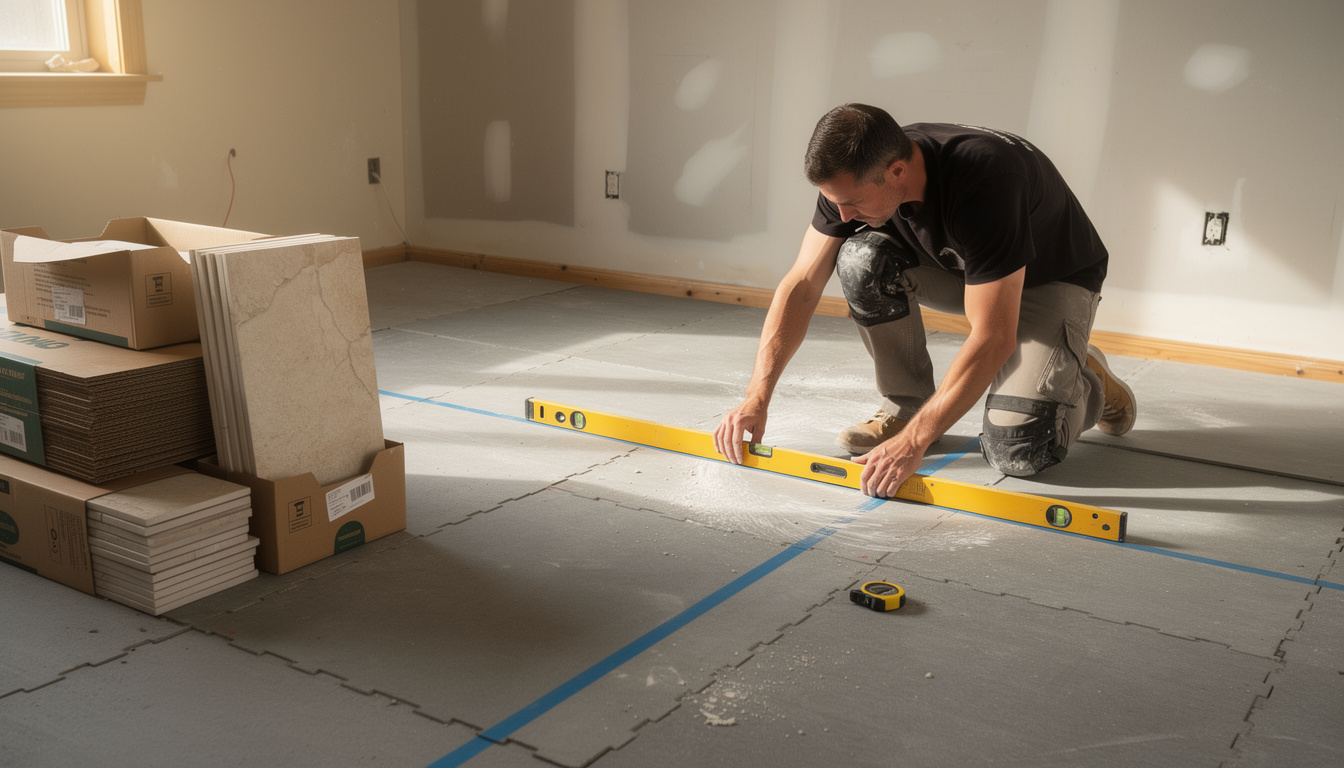
Start by checking the surface with a long level or straightedge. The practical rule: if you’ve got dips or humps bigger than about 1/8 inch over 10 feet, you’re gambling with lippage and stress points. For floors, that often means using a patching compound for low spots or carefully sanding down high ridges. The point isn’t perfection—it’s consistency, so the mortar bed can do its job without becoming a thick, uneven “shim layer.”
Stiffness matters too. If a floor flexes when you walk, tile and grout will eventually complain. Tighten loose subfloor panels, add screws where needed, and deal with squeaks now. This step is boring, but it’s cheaper than redoing an entire tile installation later.
Then clean like you mean it. Vacuum dust, scrape old adhesive, and remove grease. Mortar bonds mechanically; dust is basically a bond-breaker in disguise. Maya’s mudroom had a faint waxy cleaner residue from years of “quick mops,” so she did a thorough degrease and rinse, then let it dry fully.
Choosing the right underlayment in wet or high-traffic areas
In moisture-prone rooms, don’t tile straight onto regular drywall or questionable substrates. Cement backer board (or an uncoupling membrane, depending on the situation) gives you a stable base. For a mudroom that sees wet boots, Maya used cement board set into thin mortar and fastened with proper screws. The mortar beneath eliminates voids; the screws lock it down. Skipping the mortar under backer board is a classic DIY mistake because the board can flex between fasteners.
If you’re tiling a wall (like a shower surround), you also need a water-management plan: backer board plus a waterproofing system appropriate for the area. Tiles and grout aren’t a “bathtub”—water will find a way unless you build the assembly correctly.
A quick tool-and-material reality check
Before you move on, make sure you’re set up for the workflow. Running to the store mid-spread is how mortar dries on the floor and stress levels spike.
| Item | What it’s for | Pro tip |
|---|---|---|
| 📏 Tape measure + chalk line | Accurate reference lines for tile layout | Snap lines after cleaning so dust doesn’t blur them |
| 🧱 Notched trowel (often 1/4″ x 1/4″) | Consistent ridges for adhesive application | Match notch size to tile size and flatness |
| 🧩 Spacers | Reliable spacing tiles | Use hard spacers for floors; soft ones can compress |
| 🪚 Wet saw / manual cutter | Clean tile cutting | Wet saw for L-cuts and dense glaze; cutter for straight runs |
| 🧽 Sponge + microfiber cloth | Controlled grout cleanup | Wring sponge well to avoid washing out joints |
Get the surface right and the rest of the job becomes a sequence of manageable steps instead of constant damage control—exactly the mindset you need before you start drawing layout lines.
Tile Layout Planning: Reference Lines, Patterns, and Cut Strategy Like a Pro
A pro-looking floor rarely comes from “starting in a corner and hoping for the best.” The invisible skill is tile layout: where you begin, how you keep the pattern honest, and how you avoid ugly edge cuts. Maya’s mudroom had two doors, a closet, and a bench—so if she centered on the room’s geometry alone, the most visible doorway would end up with awkward thin cuts. Instead, she treated the main sightline (standing at the kitchen entrance looking in) as the boss.
Find your visual center, not just the mathematical center
Yes, you measure length and width, mark midpoints, and snap perpendicular lines. But you also ask: where will people notice the floor the most? That’s usually a doorway, a vanity, the front of a tub, or the open section of a kitchen. Centering the layout on that view often looks more “designed,” even if the room isn’t perfectly symmetrical.
Maya snapped a main line aligned with the kitchen threshold so the first full tiles ran straight into the space. Then she snapped a cross line at 90 degrees, using a framing square and checking diagonals. That one extra check helps prevent the slow drift that shows up 10 rows later.
Dry-laying: the fastest way to spot problems early
Before any mortar, do a dry run. Lay a row along each reference line with spacers inserted to simulate grout joints. This is where you catch “sliver tiles”—those skinny pieces under about 2 inches that scream DIY. If your dry layout produces slivers at walls, you shift the reference line by half a tile or adjust the starting point so both sides get decent-sized cuts.
Dry-laying also tells you if your tiles have slight size variation. Even modern boxed tile can vary a hair, especially across different production lots. If you notice it, keep boxes mixed as you work so variation blends naturally.
Pick a pattern you can execute cleanly
A straight stack pattern is clean and beginner-friendly. Diagonal hides some wall out-of-square issues but increases waste and tile cutting. Running bond (brick pattern) is forgiving and popular, but check your tile’s warpage: many rectangular tiles have a slight bow, so a 50% offset can exaggerate lippage. In that case, a 1/3 offset often looks better and feels flatter.
Maya chose a 1/3 offset for her 6×24 ceramic planks—modern look, fewer “trip-lip” edges. Her goal was a floor that feels smooth with socks, not just one that photographs well.
Plan movement gaps and transitions early
Tile needs room to move a little with seasonal changes. Leave a small perimeter gap at walls and cover it with baseboard or trim. Also think about transitions to adjacent floors: if you’re meeting hardwood or LVP, plan the height difference now. If you tile over existing tile (possible when the old layer is solid and level), your height builds up and doors may need trimming.
When the layout is locked, you’re ready for the messy part—mixing and spreading mortar without rushing—so the design you planned actually shows up on the floor.
Adhesive Application and Setting Ceramic Tiles: Mortar Mix, Coverage, and Leveling
This is where DIY projects either feel satisfying or start spiraling. Adhesive application isn’t about slapping on mortar; it’s about consistency, coverage, and working in a rhythm that keeps tiles adjustable while the mortar is fresh. Maya set a simple rule: only spread what she could cover in about 10–15 minutes. That kept her from fighting dried “skin” on the mortar surface.
Mix mortar like you’re aiming for control, not speed
Use thinset mortar for floors and wet areas because it cures hard and resists moisture. Add water to the bucket first, then powder, and mix with a drill paddle until it’s creamy—think peanut-butter texture that holds ridges. Let it rest for about 10 minutes (slaking), then remix. This isn’t superstition; it helps the polymers hydrate so the mortar performs as designed.
Only mix what you can use in roughly 30–40 minutes. In a warm room, that working time shrinks. Temperature matters: around 60°F to 80°F is the sweet spot for predictable curing.
Trowel technique: ridges are your friend
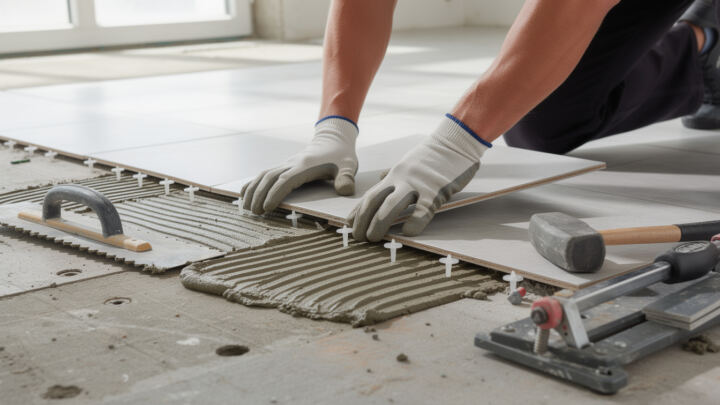
First, burn in a thin layer with the flat side of the trowel to key mortar into the substrate. Then comb with the notched side at roughly 45 degrees to create uniform ridges. Those ridges collapse when you press the tile, pushing air out and giving you better contact.
For larger tiles (often 12 inches and up), back-butter: skim a thin layer of mortar on the tile’s back. It’s a small step that massively improves coverage and reduces hollow spots. Maya back-buttered her long planks because their length makes them more sensitive to subtle floor changes.
Spacing and leveling: do it continuously, not “later”
Spacing tiles is about keeping grout joints consistent and the pattern aligned. Use spacers, but also keep an eye on the lines visually—sometimes a tile’s edge is slightly irregular, and you want the joint to read straight. Check every few tiles with a level or straightedge for leveling tiles and lippage. If you spot a tile sitting high, lift it immediately, adjust mortar, and reset. Once thinset cures, your options get loud and destructive.
Maya also lifted a tile every so often to verify coverage. She aimed for very high contact (around 90%+), especially near edges. If coverage was low, she changed her technique: slightly larger notch, better back-butter, or more consistent trowel angle. That simple habit is one of the biggest separators between “looks fine today” and “still perfect in five winters.”
Keep joints and surfaces clean while you work
As you set tiles, scrape mortar that squeezes into joints. Dried thinset in joints makes grouting harder and can leave weak, shallow grout lines. Wipe smears off tile faces before they harden. It’s way easier to clean fresh mortar than to chisel cured cement off glazed surfaces.
Once your field tile is down, walk away. Let it cure at least 24 hours before grouting—patience is part of the craft, even when it’s annoying.
Tile Cutting Like a Pro: Clean Edges, Tricky Corners, and Around Obstacles
No room is made of perfect tile-sized rectangles. Outlets, door jambs, pipes, cabinets—every one of them demands tile cutting that looks intentional. The difference between “homeowner cut” and “pro cut” isn’t a fancy saw; it’s careful measuring, smart sequencing, and knowing which tool gives the cleanest edge for that specific cut.
Measure, mark, and dry-fit before you cut
Maya kept a small “cut station” with her cutter, pencil, square, and a scrap tile for test marks. For each edge piece, she measured twice and marked once, then dry-fit the uncut tile in position to visualize the joint. She also accounted for the grout line and the perimeter expansion gap—two details that, if ignored, create cuts that are mysteriously “off” by a few millimeters.
A good habit: label cut pieces by location (like “north wall, row 4”) so you don’t mix them up. When you’re cutting a dozen similar shapes, they’re not as interchangeable as they look.
Pick the right tool: manual cutter vs wet saw
A manual score-and-snap cutter is great for straight cuts on many ceramic tiles. Score firmly once (don’t saw back and forth), then snap cleanly. For L-cuts around door trim, notches, and dense or textured glaze, a wet saw is more reliable and reduces chipping.
For curved cuts (like around a toilet flange), a series of small straight cuts with a wet saw can approximate a curve. Some people use tile nippers for small adjustments, but you want to be gentle—nipping too aggressively can fracture the glaze.
Door jambs and trim: the “this looks pro” moment
One of the cleanest-looking details is sliding tile under door casing instead of cutting around it. That usually means undercutting the jamb with a flush-cut saw so the tile tucks beneath. Maya did this at the mudroom-to-kitchen doorway, and it instantly made the project feel like a professional install. It’s a small trick with a big visual payoff.
Edge finishing and consistency
Any exposed edge needs a plan: a bullnose piece, a metal edge trim, or a transition profile. Don’t leave raw cut edges where people will see them. If you must expose a cut, dress it lightly with a rubbing stone so it’s not sharp and the glaze edge looks cleaner.
Clean cuts reduce stress points too. A jagged corner can become a crack starter over time, especially in high-traffic spots. So while cutting feels like “detail work,” it actually supports durability.
With cuts done and tiles cured, you’re ready for the finishing phase where the whole surface suddenly “locks in”: grout, cleanup timing, and protection.
Grouting and Sealing Tiles: Crisp Joints, No Haze, and Easy Maintenance
Grouting is the part everyone wants to rush because the room finally looks “almost done.” But grout is also where a lot of installs get their first ugly scars: blotchy joints, pinholes, crumbling corners, or a permanent cloudy haze on the tile face. Maya treated grout day like a separate project with its own pacing—music on, phone away, and a plan for cleanup timing.
Choose the right grout and mix it consistently
Use sanded grout for wider joints (commonly over 1/8 inch) and unsanded for tighter lines so it packs smoothly without scratching. Mix to a thick, workable consistency, let it rest briefly, then remix. The goal is a grout that spreads without slumping and packs joints without voids.
Work in manageable zones. Push grout diagonally across joints with a rubber float, forcing it in rather than just smearing over the top. Then hold the float at a steeper angle to scrape excess off the tile face.
Cleanup timing: the difference between clean tile and endless haze
Wait a short time—often 15–20 minutes, depending on humidity and grout type—then wipe with a well-wrung damp sponge. Too wet and you wash grout out of joints; too early and you pull it right back out. Rinse the sponge frequently and keep your water clean. After the first pass, do a second light pass to smooth joints and remove remaining film.
Once everything dries, buff with a microfiber cloth. If you still see haze the next day, a gentle haze remover made for tile can help, but the easiest path is getting the wipe timing right in the first place.
Sealing tiles and grout: what actually needs it
Sealing tiles depends on the tile type. Most glazed ceramic doesn’t need sealing because the glaze is already protective. Grout, however, is porous. After grout cures (often around 72 hours—follow the product), apply a grout sealer to reduce staining and make routine cleaning easier. In real life, this matters in kitchens and mudrooms where spills and grime are inevitable.
Maya sealed her grout lines and made a simple maintenance routine: mild cleaner, no harsh acids, and reseal every year or two depending on traffic. That’s not fussy; it’s how you keep light grout from turning permanently dingy.
Common mistakes that quietly ruin a great-looking install
- ⚠️ Skipping floor preparation and hoping mortar “levels it out”
- ⚠️ Spreading too much thinset and letting it skin over before setting tiles
- ⚠️ Forgetting consistent spacing tiles and trying to “eyeball” straight lines
- ⚠️ Not checking coverage and ending up with hollow spots that crack later
- ⚠️ Walking on tile before cure time and locking in uneven edges
- ⚠️ Sealing too early (trapping moisture) or never sealing grout at all
When grout is cured, sealed, and cleaned, the floor finally feels finished—solid, smooth, and easy to live with—which is exactly the payoff you were chasing from the start.
Can I install ceramic tiles over existing tile?
Yes, if the old surface is solid, clean, and flat with no loose pieces. Scuff-sand glossy glaze, use a bonding primer if required by your mortar system, and plan for the added height at doors and transitions. If the existing layer is cracked or moving, remove it—new tile will only copy those problems.
What’s the safest way to prevent lippage when leveling tiles?
Use a straightedge frequently, keep mortar ridges consistent, and adjust immediately while thinset is wet. For large-format pieces, back-butter and consider a leveling clip system to help keep edges aligned. Lippage is easier to prevent than to fix after curing.
How long should I wait before grouting and then sealing?
Typically, wait at least 24 hours after setting tiles before grouting (longer if conditions are cool or humid). After grouting, let joints cure per the grout instructions—often around 48–72 hours—before applying sealer. Rushing these windows can weaken the finish and lead to discoloration.
Do I really need expansion gaps around the perimeter?
Yes. Tile and substrates move slightly with temperature and humidity changes. Leaving a small gap at walls and fixed obstacles helps prevent tenting (tiles lifting) and cracked grout at edges. The gap gets covered by baseboard or trim, so you won’t see it.